English
 Español
 tiếng việt
 русский
High elasticity and excellent rebound resilience for dynamic sealing and cushioning applications.
Good processability via injection molding and extrusion, with low melt viscosity and narrow molecular weight distribution.
Outstanding weather resistance and UV stability without requiring additional stabilizers.
Low-temperature flexibility down to −40 °C while maintaining dimensional stability.
Non-toxic formulation compliant with FDA 21 CFR §177.2600 for incidental food contact applications.
Automotive interior trim components including soft-touch door panels and instrument cluster bezels.
Consumer electronics housings and protective overmolded grips for power tools and handheld devices.
Medical device components such as ergonomic handles, non-lubricated seals, and tubing connectors.
Household appliance parts including dishwasher door gaskets, washing machine dampers, and vacuum cleaner wheels.
Industrial grips and anti-slip surfaces for hand tools, conveyor accessories, and modular assembly fixtures.
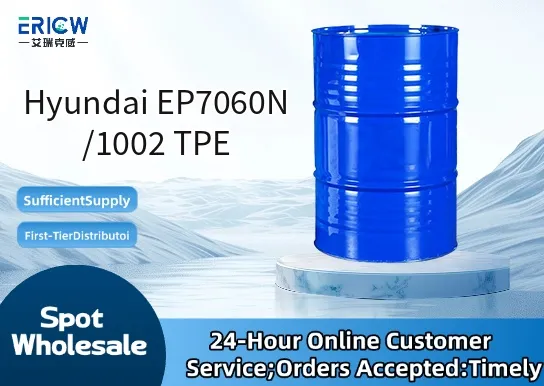
| Chemical Type | Styrenic Thermoplastic Elastomer (TPE-S) |
| Product Form | Pellets |
| Appearance | Translucent light amber granules |
| Hardness (Shore A) | 60 ± 3 |
| Melt Flow Rate (230 °C / 2.16 kg) | 18–22 g/10 min |
| Density | 0.90–0.92 g/cm³ |
| Primary Applications | Overmolding, soft-touch finishing, dynamic sealing |
| Key Features | Elastic recovery, thermal reversibility, recyclability |
Q1: What is the primary polymer base of Hyundai EP7060N/1002 TPE?
A: Hyundai EP7060N/1002 is a thermoplastic elastomer based on a styrenic block copolymer (SBC) architecture, offering a balanced combination of rubber-like elasticity and thermoplastic processability.
Q2: Is this grade suitable for overmolding onto polypropylene (PP) or polyethylene (PE)?
A: Yes — EP7060N/1002 is specifically formulated to provide good adhesion to common polyolefins such as PP and HDPE when processed under standard injection molding conditions, without requiring primers or surface pretreatment in many applications.
Q3: What are the recommended drying conditions prior to processing?
A: To ensure optimal melt stability and surface quality, it is recommended to dry EP7060N/1002 at 70–80 °C for 2–4 hours using desiccant-assisted air circulation. Extended drying beyond this range is not typically required unless ambient humidity is exceptionally high.
Q4: Can this TPE be used in applications requiring food contact compliance?
A: While EP7060N/1002 is manufactured using FDA-compliant raw materials and is commonly selected for food-contact-adjacent applications (e.g., seals, grips, non-leaching components), final regulatory approval depends on the full formulation, processing conditions, and end-use requirements. Users should conduct appropriate testing and consult local regulatory guidance.
Q5: How does EP7060N/1002 compare to conventional SEBS-based TPEs in terms of softness and compression set?
A: This grade delivers enhanced soft-touch characteristics and improved recovery after deformation compared to standard SEBS grades, owing to its tailored microstructure and optimized plasticizer system — making it well-suited for applications demanding low compression set and long-term tactile integrity.
Contact With Us:
E-mail: wangxingqiang@ericwchem.com
Have a Questions? Call Us:
Add:
Building A1, Jiete Industrial Park, Huangpu District, Guangzhou City, Guangdong Province, China