English
 Español
 tiếng việt
 русский
Excellent abrasion resistance for demanding mechanical environments.
High elasticity and outstanding rebound resilience at room temperature.
Good low-temperature flexibility down to –40 °C.
Processable via standard thermoplastic techniques including extrusion, injection molding, and blow molding.
Hydrolysis-stabilized formulation suitable for humid or wet-condition applications.
Industrial conveyor belts and wear strips.
Dynamic seals and gaskets in hydraulic/pneumatic systems.
High-performance footwear midsoles and outsoles.
Automotive interior trim components requiring soft-touch feel and durability.
Medical tubing and non-implantable fluid-handling devices.
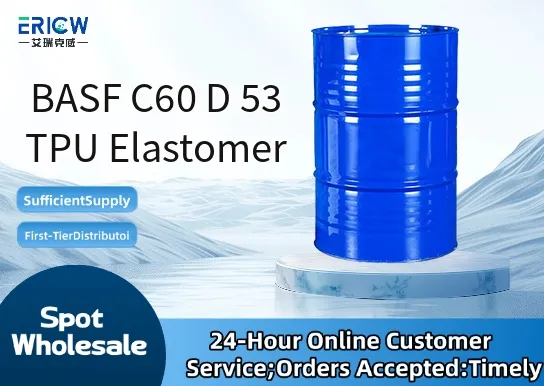
| Chemical Type | Thermoplastic Polyurethane (TPU), polyester-based |
| Product Form | Natural granules, free-flowing pellets |
| Appearance | Opaque, off-white to light beige |
| Hardness (Shore A) | 53 ± 2 |
| Density (g/cm³) | 1.18–1.20 |
| Melt Flow Index (230 °C/2.16 kg) | 10–14 g/10 min |
| Primary Applications | Dynamic elastomeric parts requiring fatigue resistance and dimensional stability |
| Key Features | Abrasion resistance, elasticity, hydrolysis stability, processability |
Q1: What is the primary distinction of C60 D 53 compared to other thermoplastic polyurethane elastomers in the BASF Elastollan® portfolio?
A: C60 D 53 is a medium-hardness, ester-based TPU offering a balanced combination of melt processability, mechanical resilience, and abrasion resistance. Unlike higher-durometer grades, it provides enhanced flexibility and impact performance at lower processing temperatures, making it especially suitable for thin-wall extrusion and precision injection molding of dynamic components.
Q2: Is C60 D 53 compatible with common polymer blending systems such as PVC, ABS, or polyolefins?
A: C60 D 53 exhibits good compatibility with polar polymers like PVC and certain engineering thermoplastics when properly formulated with compatibilizers. It is generally not recommended for direct blending with non-polar polyolefins without functionalized coupling agents, due to polarity mismatch and potential phase separation during processing.
Q3: What drying conditions are recommended prior to processing C60 D 53?
A: As an ester-based TPU, C60 D 53 is hygroscopic and must be thoroughly dried before melt processing. Typical drying involves 3–4 hours at 80–90 °C under dehumidified air, with residual moisture maintained below 0.05 wt% to prevent hydrolytic degradation and surface defects.
Q4: Can C60 D 53 be used in applications requiring repeated flexing or cyclic loading?
A: Yes — its molecular architecture delivers excellent dynamic mechanical performance, including high tensile set recovery and fatigue resistance. It is frequently selected for continuously flexing parts such as bellows, gaskets, and wearable device housings where long-term dimensional stability under cyclic stress is critical.
Contact With Us:
E-mail: wangxingqiang@ericwchem.com
Have a Questions? Call Us:
Add:
Building A1, Jiete Industrial Park, Huangpu District, Guangzhou City, Guangdong Province, China