English
 Español
 tiếng việt
 русский
Excellent abrasion resistance for demanding mechanical environments.
High tensile strength and elongation at break for dynamic flexibility.
Good low-temperature flexibility down to –40 °C.
Outstanding oil, grease, and hydrocarbon resistance.
Processable via extrusion, injection molding, and blow molding.
Automotive interior trim components including door panels and armrests.
Industrial hoses and pneumatic tubing requiring durability and kink resistance.
Consumer electronics protective casings and wearable device straps.
Medical tubing and non-invasive fluid handling components.
Footwear midsoles and performance outsoles.
| Chemical Type | Aliphatic polyester-based thermoplastic polyurethane |
| Product Form | Pellets |
| Appearance | Opaque off-white to light tan granules |
| Shore D Hardness (ASTM D2240) | 75 ± 2 |
| Tensile Strength (ASTM D412) | ≈ 45 MPa |
| Elongation at Break (ASTM D412) | ≈ 550 % |
| Melt Flow Rate (ASTM D1238, 230 °C/2.16 kg) | 8–12 g/10 min |
| Density (ASTM D792) | 1.18–1.20 g/cm³ |
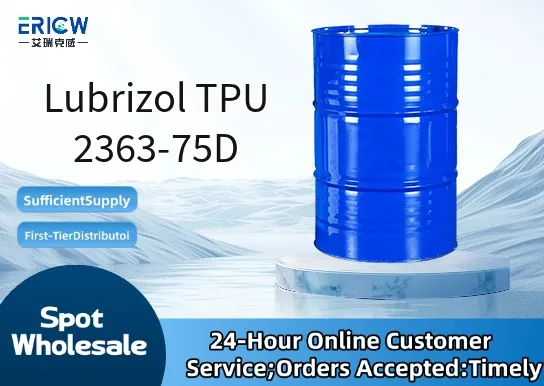
Q1: What is Lubrizol TPU 2363-75D primarily used for?
A: Lubrizol TPU 2363-75D is a thermoplastic polyurethane elastomer designed for demanding extrusion and injection molding applications, especially where high melt strength, excellent abrasion resistance, and good low-temperature flexibility are required — commonly used in automotive trim, industrial hoses, and premium consumer goods.
Q2: Is TPU 2363-75D compatible with common engineering plastics like ABS or PC?
A: It exhibits limited miscibility with rigid amorphous polymers such as ABS or polycarbonate; however, it can be effectively used in co-extruded or overmolded structures where interfacial adhesion is enhanced through proper surface treatment or compatibilizer selection. Blending without modification is not generally recommended.
Q3: How should TPU 2363-75D be dried prior to processing?
A: Like most hygroscopic TPUs, it must be thoroughly dried before melt processing to avoid surface defects and molecular weight degradation. Recommended drying conditions are typically 80–90 °C for 2–4 hours using desiccant-assisted dryers, with moisture content maintained below 0.02%.
Q4: Does this grade offer inherent UV or hydrolysis resistance?
A: TPU 2363-75D is based on polyester chemistry and therefore offers good mechanical retention in ambient conditions but has only moderate resistance to prolonged UV exposure and hydrolytic environments. Stabilizer packages or protective topcoats are advised for long-term outdoor or high-humidity applications.
Contact With Us:
E-mail: wangxingqiang@ericwchem.com
Have a Questions? Call Us:
Add:
Building A1, Jiete Industrial Park, Huangpu District, Guangzhou City, Guangdong Province, China