English
 Español
 tiếng việt
 русский
Excellent abrasion resistance for demanding dynamic applications.
High tensile strength and elongation at break for robust mechanical performance.
Good low-temperature flexibility down to –30 °C.
Processable via extrusion, injection molding, and blow molding.
Compatible with common plasticizers and additives for formulation flexibility.
Automotive interior trim components including door panels and instrument bezels.
Industrial hoses and pneumatic tubing requiring fatigue resistance.
Consumer electronics protective casings and wearable device bands.
Medical tubing and non-implantable fluid handling components.
Footwear midsoles and outsole compounds for athletic and casual footwear.
| Chemical Type | Thermoplastic Polyurethane (TPU), polyester-based |
| Product Form | Pellets |
| Appearance | Off-white to light tan, free-flowing granules |
| Shore A Hardness | 90 ± 2 |
| Melt Flow Rate (210 °C / 5 kg) | 12–16 g/10 min |
| Tensile Strength (ASTM D412) | 38–42 MPa |
| Elongation at Break (ASTM D412) | 450–520 % |
| Density (ASTM D792) | 1.18–1.20 g/cm³ |
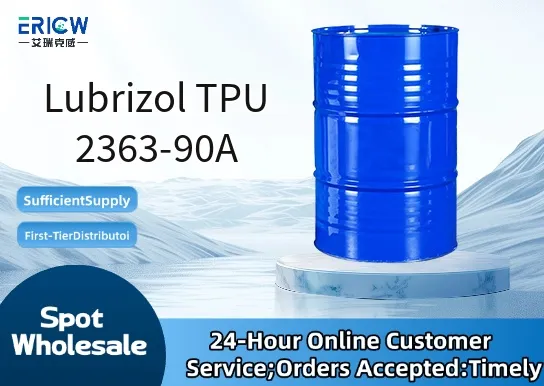
Q1: What is Lubrizol TPU 2363-90A primarily used for?
A: Lubrizol TPU 2363-90A is a thermoplastic polyurethane elastomer designed for demanding extrusion and injection molding applications, particularly in automotive interior trim, industrial hoses, and high-performance consumer goods where excellent abrasion resistance, flexibility, and processability are required.
Q2: Is TPU 2363-90A compatible with common engineering thermoplastics like ABS or PC?
A: Yes, TPU 2363-90A demonstrates good compatibility with several engineering thermoplastics—including ABS, PC, and certain polyolefins—making it suitable for co-extrusion and overmolding applications. Compatibility should be verified through melt flow and adhesion testing under actual processing conditions.
Q3: What drying requirements does TPU 2363-90A have before processing?
A: Like most hygroscopic TPUs, TPU 2363-90A must be thoroughly dried prior to processing to prevent surface defects and molecular degradation. Recommended drying is typically at 80–90 °C for 2–4 hours using a desiccant dryer, with moisture content maintained below 0.02%.
Q4: How does TPU 2363-90A perform in low-temperature environments?
A: TPU 2363-90A retains good flexibility and impact resistance at sub-zero temperatures, supporting reliable performance in applications exposed to cold climates or refrigerated service conditions—though exact low-temperature limits depend on part geometry and stress conditions.
Contact With Us:
E-mail: wangxingqiang@ericwchem.com
Have a Questions? Call Us:
Add:
Building A1, Jiete Industrial Park, Huangpu District, Guangzhou City, Guangdong Province, China