English
 Español
 tiếng việt
 русский
Excellent resistance to ozone, UV radiation, and weathering without requiring additional stabilizers.
Outstanding flexibility and elasticity at low temperatures down to –40 °C.
Good adhesion to various substrates including metals, plastics, and painted surfaces.
Low compression set, ensuring long-term sealing performance under dynamic stress.
Compatible with common acrylic-based coatings and solvent-based formulation systems.
Automotive exterior trim seals and gaskets.
Weather-resistant architectural sealants for façade joints.
Flexible protective coatings for metal roofing and cladding.
Adhesive components in high-durability label facestocks.
Base polymer for specialty elastomeric tapes used in industrial bonding.
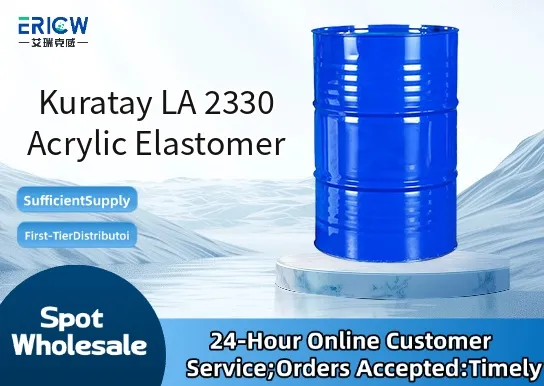
| Chemical Type | Acrylic elastomer (copolymer of alkyl acrylates) |
| Product Form | Pellets |
| Appearance | Off-white to light tan, free-flowing granules |
| Typical Density (23 °C) | 1.02–1.05 g/cm³ |
| Hardness (Shore A, ASTM D2240) | 75–82 |
| Mooney Viscosity (ML 1+4 @ 100 °C) | 45–60 |
| Service Temperature Range | –40 °C to +120 °C (continuous) |
| Key Benefits | Long-term weather stability, low-temperature flexibility, and processing ease via extrusion or calendering |
Q1: What is the primary function of Kuratay LA 2330 in polymer formulations?
A: Kuratay LA 2330 functions as a reactive acrylic elastomer modifier, primarily used to enhance impact resistance, flexibility, and low-temperature toughness in rigid thermoplastics—especially acrylic-based systems such as PMMA and certain engineering blends.
Q2: Is Kuratay LA 2330 compatible with standard acrylic processing methods?
A: Yes—it is designed for compatibility with conventional thermoplastic processing techniques including extrusion, injection molding, and pellet compounding. Its reactive functionality allows for covalent integration into the matrix when processed under appropriate thermal conditions.
Q3: How does Kuratay LA 2330 differ from non-reactive acrylic impact modifiers?
A: Unlike non-reactive modifiers, Kuratay LA 2330 contains pendant reactive groups that can participate in grafting or crosslinking reactions during melt processing—leading to improved interfacial adhesion, reduced phase separation, and more stable mechanical performance over time.
Q4: What are typical dosage levels for optimal performance?
A: Dosage depends on the base resin and target property balance, but it is typically used at low concentrations—generally ranging from 0.1% to 2% by weight—to achieve meaningful toughening without compromising clarity or processability in transparent acrylic applications.
Q5: Can Kuratay LA 2330 be used in food-contact or medical-grade formulations?
A: While Kuratay LA 2330 is not pre-certified for regulated end uses, its composition is based on acrylic monomers commonly employed in functional polymer additives. Formulators must conduct full regulatory evaluation—including extractables testing and compliance verification—based on their specific application, processing conditions, and regional requirements.
Contact With Us:
E-mail: wangxingqiang@ericwchem.com
Have a Questions? Call Us:
Add:
Building A1, Jiete Industrial Park, Huangpu District, Guangzhou City, Guangdong Province, China