English
 Español
 tiếng việt
 русский
Excellent balance of toughness and flexibility at low temperatures down to –40 °C.
High resistance to hydrolysis, oils, greases, and many common automotive fluids.
Outstanding long-term creep resistance and dimensional stability under dynamic loading.
Good processability via injection molding and extrusion with low moisture sensitivity.
UL94 HB flame retardancy rating without halogenated additives.
Automotive air ducts and HVAC components requiring thermal cycling durability.
Powertrain grommets and vibration-damping mounts exposed to engine bay conditions.
Industrial fluid-handling hoses and couplings for hydraulic and pneumatic systems.
Consumer appliance parts such as dishwasher pump housings and washing machine actuators.
Medical device tubing connectors where biocompatibility (ISO 10993-compliant) and kink resistance are critical.
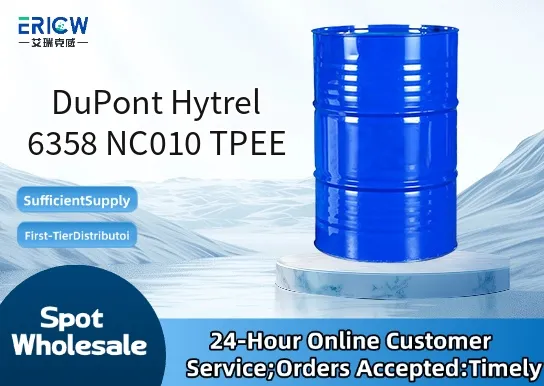
| Chemical Type | Thermoplastic polyester elastomer (TPEE) |
| Product Form | Natural color pellets |
| Appearance | Opaque, off-white granules |
| Primary Applications | Dynamic structural components in demanding thermal/mechanical environments |
| Key Features | Hydrolysis resistance, low-temperature flexibility, high fatigue life |
| Benefits | Extended service life vs. conventional TPEs; reduced part count through overmolding capability |
| Processing Method | Injection molding, extrusion, blow molding |
| Standard Compliance | RoHS 2011/65/EU compliant; REACH SVHC-free |
Q1: What are the key processing advantages of Hytrel 6358 NC010 compared to conventional TPEEs?
A: Hytrel 6358 NC010 is a low-melt-viscosity grade specifically engineered for improved flow in thin-wall and complex-geometry injection molding. It offers faster cycle times and enhanced mold-filling capability while retaining the high-temperature performance and dynamic fatigue resistance characteristic of the Hytrel TPEE family.
Q2: Is Hytrel 6358 NC010 suitable for applications requiring repeated flexing or cyclic loading?
A: Yes — as a thermoplastic polyester elastomer, Hytrel 6358 NC010 delivers excellent resilience, high tensile strength, and outstanding retention of mechanical properties after repeated deformation. It is widely selected for dynamic components such as power tool grips, automotive bellows, and flexible couplings where long-term fatigue resistance is critical.
Q3: How does Hytrel 6358 NC010 perform under elevated temperature conditions?
A: Hytrel 6358 NC010 maintains structural integrity and elastic recovery at continuous use temperatures up to approximately 120–130 °C, with short-term exposure tolerance extending higher. Its thermal stability supports applications in under-hood automotive environments and industrial equipment housings exposed to intermittent heat.
Q4: Can Hytrel 6358 NC010 be overmolded onto common engineering plastics?
A: Yes — Hytrel 6358 NC010 exhibits good adhesion to many thermoplastics including polypropylene (PP), polyamide (PA), and polycarbonate (PC) when appropriate processing parameters (e.g., melt temperature, mold surface temperature, and dwell time) are optimized. Adhesion strength depends on substrate preparation and interfacial compatibility, and may benefit from surface treatment or primer systems in demanding assemblies.
Contact With Us:
E-mail: wangxingqiang@ericwchem.com
Have a Questions? Call Us:
Add:
Building A1, Jiete Industrial Park, Huangpu District, Guangzhou City, Guangdong Province, China