English
 Español
 tiếng việt
 русский
High thermal stability suitable for processing temperatures up to 800°C.
Excellent lightfastness and weather resistance in outdoor applications.
Low soluble salt content, minimizing corrosion risk in metal-coated systems.
Consistent particle size distribution ensuring uniform dispersion and color strength.
Non-toxic formulation compliant with major global regulatory frameworks (RoHS, REACH).
Ceramic glazes and frits for architectural tiles and tableware.
High-temperature coatings for industrial furnaces and exhaust components.
Coloration of refractory materials including fire bricks and castables.
Pigmentation of glass enamels and decorative glass products.
Stabilized colorant in UV-curable and powder coating systems requiring heat endurance.
| Chemical Type | Mixed-metal oxide (lead-free chromate alternative) |
| Product Form | Fine dry powder |
| Appearance | Bright yellow granular powder |
| Primary Applications | Ceramics, high-temperature coatings, refractories, glass enamels |
| Key Features | Thermal stability, lightfastness, low solubility, heavy-metal free |
| Benefits | Color consistency, process compatibility, regulatory compliance, long-term durability |
| pH (10% aqueous slurry) | 6.5–7.5 |
| Volatile Matter (105°C, 2 hrs) | ≤0.5 wt% |
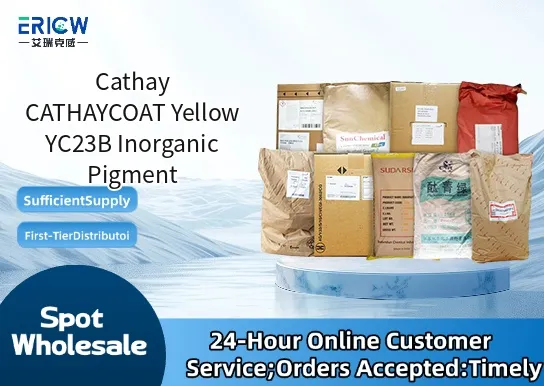
Q1: What is the primary chemical composition of Cathay CATHAYCOAT Yellow YC23B?
A: Cathay CATHAYCOAT Yellow YC23B is a high-performance inorganic yellow pigment based on a modified lead chromate-free complex oxide system, engineered for enhanced thermal stability and lightfastness in demanding industrial applications.
Q2: Is this pigment suitable for use in heat-sensitive polymer systems such as polyolefins or PVC?
A: Yes — YC23B exhibits excellent thermal stability and is routinely processed in extrusion and injection molding operations up to 280 °C without significant hue shift or decomposition, making it well-suited for polyolefins, PVC, and engineering thermoplastics.
Q3: How does YC23B perform under outdoor weathering conditions?
A: This pigment delivers outstanding UV resistance and chalk resistance due to its dense crystalline structure and surface treatment, maintaining color strength and hue integrity in exterior coatings and plastic profiles exposed to prolonged sunlight and moisture.
Q4: Can YC23B be used in water-based coating systems?
A: Yes — with appropriate dispersion protocols and compatible surfactants, YC23B achieves stable, low-viscosity dispersions in acrylic, styrene-acrylic, and PUD-based waterborne systems, supporting consistent color development and film integrity.
Q5: What are typical dosage ranges when using YC23B in industrial coatings?
A: Dosage depends on the required opacity, substrate, and application method, but YC23B is typically used at low concentrations — generally ranging from 0.1% to 2% by weight in the final formulation — due to its high tinting strength and efficient light absorption.
Contact With Us:
E-mail: wangxingqiang@ericwchem.com
Have a Questions? Call Us:
Add:
Building A1, Jiete Industrial Park, Huangpu District, Guangzhou City, Guangdong Province, China