English
 Español
 tiếng việt
 русский
High thermal stability with glass transition temperature (Tg) exceeding 180 °C after curing.
Excellent chemical resistance to acids, alkalis, and solvents in demanding industrial environments.
Low viscosity formulation enabling easy processing, impregnation, and void-free encapsulation.
Outstanding electrical insulation properties suitable for high-voltage and aerospace-grade applications.
Halogen-free composition compliant with RoHS and REACH regulatory requirements.
High-reliability encapsulation of power semiconductor modules (e.g., IGBTs and SiC devices).
Advanced printed circuit board (PCB) underfill and molding compounds for automotive electronics.
Thermal interface materials and bonding adhesives in electric vehicle battery management systems.
Insulating coatings and potting compounds for high-frequency transformers and inductors.
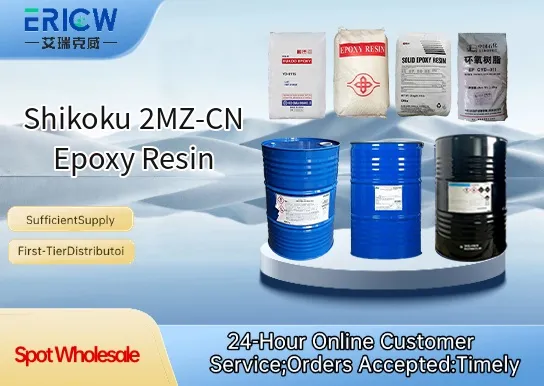
| Chemical Type | Multi-functional epoxy resin based on bisphenol-F and cyanurate structure |
| Product Form | Off-white to light yellow solid granules or powder |
| Appearance | Free-flowing crystalline solid at room temperature |
| Primary Applications | High-performance encapsulation, molding, and structural adhesives |
| Key Features | High Tg, low moisture absorption, excellent dielectric strength |
| Benefits | Enhanced long-term reliability under thermal cycling and humidity stress |
| Storage Conditions | Store below 25 °C in dry, sealed containers; protect from moisture |
Q1: What is the primary function of Shikoku 2MZ-CN in epoxy formulations?
A: Shikoku 2MZ-CN is a latent imidazole-type curing agent designed to provide controlled reactivity and extended pot life at ambient temperature, while enabling rapid and efficient crosslinking upon thermal activation—commonly used in high-performance structural adhesives, prepregs, and encapsulation systems.
Q2: How does 2MZ-CN compare to conventional imidazole accelerators in terms of handling stability?
A: Unlike highly reactive imidazoles, 2MZ-CN exhibits superior latency and storage stability in one-part epoxy systems due to its crystalline structure and moderated basicity, reducing premature gelation risk during processing and extending shelf life under recommended conditions.
Q3: What is the typical activation temperature range for full cure with 2MZ-CN?
A: Full network development generally occurs between 130 °C and 170 °C, depending on formulation composition and desired cure profile. Lower-temperature cures are possible with extended dwell times, while higher temperatures accelerate gelation and final hardness development.
Q4: Is 2MZ-CN compatible with standard diglycidyl ether of bisphenol-A (DGEBA) resins and other common epoxy types?
A: Yes—2MZ-CN demonstrates broad compatibility with DGEBA, novolac epoxies, cycloaliphatic epoxies, and multifunctional epoxy resins. Compatibility should be verified empirically in each specific formulation, particularly when additives or fillers are present.
Q5: What safety and handling precautions should be observed when working with 2MZ-CN?
A: As with all fine organic powders, avoid inhalation of dust and direct skin contact. Use appropriate PPE—including gloves, safety goggles, and respiratory protection where dust generation is likely. Store in a cool, dry place away from strong acids, oxidizers, and moisture.
Contact With Us:
E-mail: wangxingqiang@ericwchem.com
Have a Questions? Call Us:
Add:
Building A1, Jiete Industrial Park, Huangpu District, Guangzhou City, Guangdong Province, China