English
 Español
 tiếng việt
 русский
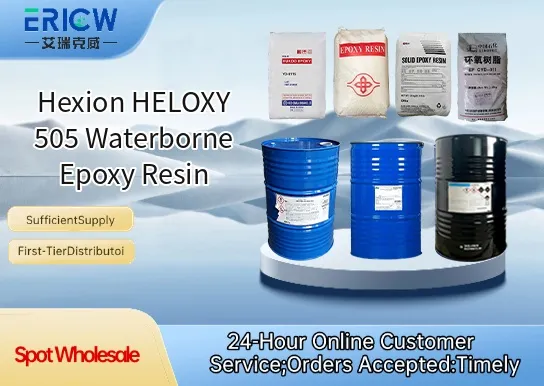
Low-VOC, waterborne formulation compliant with stringent environmental regulations.
Excellent hydrolytic stability and shelf life in aqueous dispersion.
Good compatibility with amine-based curing agents for ambient or heat-cure systems.
Enables high-gloss, durable films with strong adhesion to metals and concrete substrates.
Reduced odor and improved workplace safety compared to solvent-borne epoxy resins.
Waterborne industrial maintenance coatings for steel structures and pipelines.
Concrete floor coatings requiring low-emission, high-durability performance.
Primers for automotive and agricultural equipment OEM and refinish applications.
High-performance can and coil coatings where regulatory compliance is critical.
| Chemical Type | Waterborne bisphenol-A based epoxy dispersion |
| Product Form | Off-white to light yellow aqueous dispersion |
| Appearance | Opaque liquid, homogeneous without sedimentation |
| Non-Volatile Content (wt%) | 48–52% |
| pH (at 25°C) | 7.0–8.5 |
| Viscosity (mPa·s, Brookfield RVT, #3 spindle, 20 rpm) | 200–600 |
| Density (g/cm³ at 25°C) | 1.05–1.10 |
| Particle Size (D50, nm) | 120–180 |
Q1: What is the primary function of HELOXY 505 in waterborne epoxy systems?
A: HELOXY 505 serves as a reactive diluent and viscosity modifier, enabling improved handling and film formation while maintaining epoxy functionality in low-VOC, water-based formulations.
Q2: Can HELOXY 505 be used in direct-to-metal (DTM) coatings?
A: Yes — it is commonly incorporated into waterborne DTM epoxy primers and basecoats to enhance adhesion, corrosion resistance, and crosslink density without compromising water dispersibility.
Q3: How does HELOXY 505 compare to conventional glycidyl ether diluents in terms of water compatibility?
A: Unlike many hydrophobic glycidyl ethers, HELOXY 505 is specifically designed for waterborne systems, offering inherent colloidal stability and reduced risk of phase separation during emulsification or storage.
Q4: Is HELOXY 505 compatible with common amine-based waterborne curing agents?
A: Yes — it demonstrates good reactivity and compatibility with aliphatic and cycloaliphatic polyamine dispersions, supporting efficient ambient- or elevated-temperature cure profiles in two-component systems.
Contact With Us:
E-mail: wangxingqiang@ericwchem.com
Have a Questions? Call Us:
Add:
Building A1, Jiete Industrial Park, Huangpu District, Guangzhou City, Guangdong Province, China