English
 Español
 tiếng việt
 русский
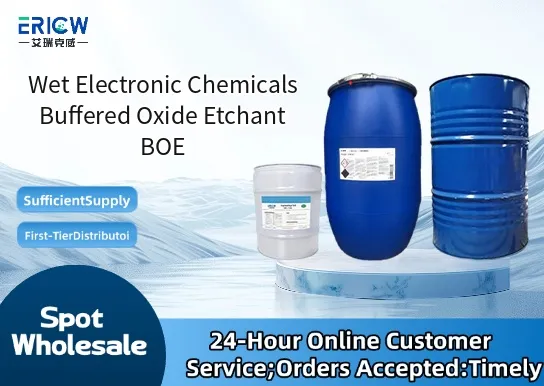
Precisely buffered HF/NH₄F formulation ensures stable etch rate and exceptional uniformity across silicon dioxide layers.
Low particle count (<1 particle/mL @ ≥0.5 µm) and ultra-high purity (SEMI C1/C7 grade) minimize defect generation in critical semiconductor processes.
Controlled pH (4.0–4.8) and buffering capacity reduce sensitivity to temperature drift and dilution errors during wet bench operation.
Non-volatile ammonium fluoride base minimizes fuming, improves workplace safety, and enables longer bath life versus unbuffered HF.
Compatible with standard quartz, PFA, and HDPE wet processing equipment—no special material handling required.
Gate oxide and field oxide removal in CMOS and memory device fabrication.
Photoresist stripping post-SiO₂ etch with minimal underlying silicon or nitride attack.
Surface cleaning and native oxide removal prior to epitaxial growth or metal deposition.
MEMS release etching for high-aspect-ratio silicon dioxide structures.
Back-end-of-line (BEOL) interlayer dielectric (ILD) trimming and planarization adjustment.
| Chemical Type | Aqueous buffered hydrofluoric acid solution (HF/NH₄F) |
| Product Form | Liquid concentrate (ready-to-use or dilutable) |
| Appearance | Clear, colorless, low-viscosity liquid |
| Primary Applications | Silicon dioxide (SiO₂), TEOS, BPSG, and FSG etching |
| Key Features | Stable etch rate (±5% over 24 h at 25°C), low metal ion contamination (<10 ppt each of Na, K, Fe, Cu, Al) |
| Benefits | High selectivity to Si₃N₄ (>100:1) and Si (>500:1); reduced undercut; improved CD control |
| Regulatory Compliance | REACH compliant; RoHS 2015/863 Annex II compliant; SDS available per GHS Rev. 8 |
| Storage Conditions | Store at 10–25°C in original HDPE or PFA-lined container; protect from direct sunlight |
| Common Compatible Systems | Suitability |
| Modutek WET Series (e.g., WET-1200, WET-2200) | Highly Recommended – Optimized for BOE delivery, temperature control, and recirculation stability |
| SEMES S-Wet Platform | Highly Recommended – Validated for low-particulate BOE processing with integrated filtration |
| Screen Semiconductor SC-2000 Series | Recommended – Requires optional quartz manifold upgrade for extended chemical compatibility |
| Technics WaferBench Pro | Suitable – Manual or semi-automated use; confirm PFA/Nalgene® fluid path compatibility |
Q1: What is the CAS Registry Number for Buffered Oxide Etchant (BOE)?
A: BOE is a proprietary mixture and does not have a single CAS number; key components include Hydrofluoric acid (CAS 7664-39-3) and Ammonium fluoride (CAS 12125-01-8). Full compositional disclosure is provided under NDA.
Q2: What is the typical working concentration and etch rate for BOE on thermal SiO₂ at 25°C?
A: Standard ready-to-use BOE (e.g., 6:1 NH₄F:HF ratio) provides ~700–900 Å/min etch rate on 1000 Å thermal SiO₂ at 25°C; rate varies predictably with temperature (±15% per 5°C change).
Q3: How does BOE compare to dilute HF in terms of selectivity and process control?
A: BOE offers significantly higher SiO₂/Si selectivity (>500:1 vs. ~100:1 for 0.5% HF), reduced silicon pitting, and superior etch rate stability due to pH buffering—critical for sub-28 nm node manufacturing.
Q4: Are there extractables or leachables concerns when using BOE in PFA or fluoropolymer systems?
A: BOE shows negligible leaching from high-purity PFA, ETFE, or quartz systems when operated within recommended temperature and concentration ranges; extractables testing per SEMI F57 confirms <0.1 ppb fluorinated organics after 72 h contact.
Q5: Does this BOE product meet ISO 14644-1 Class 1 cleanroom handling requirements?
A: Yes—manufactured and packaged in ISO 14644-1 Class 1 (at 0.1 µm) cleanrooms; certified for particle counts ≤1 particle/m³ @ ≥0.1 µm in final sealed containers.
Contact With Us:
E-mail: wangxingqiang@ericwchem.com
Have a Questions? Call Us:
Add:
Building A1, Jiete Industrial Park, Huangpu District, Guangzhou City, Guangdong Province, China