English
 Español
 tiếng việt
 русский
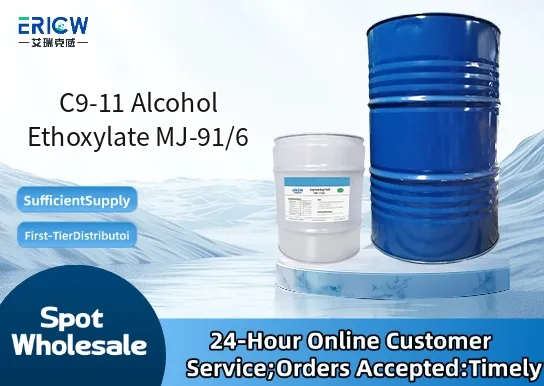
Balanced hydrophile-lipophile balance (HLB ~13.5) optimized for effective emulsification and detergency in aqueous systems.
Low-foaming profile suitable for high-shear industrial cleaning and metalworking applications.
Excellent water solubility and stability across a broad pH range (pH 5–11).
Biodegradable under OECD 301 standard conditions, supporting sustainable formulation goals.
Low volatility and negligible odor, enhancing operator safety and handling comfort.
Industrial and institutional (I&I) hard-surface cleaners, including floor, tile, and stainless-steel cleaners.
Metalworking fluid emulsifiers and co-surfactants in semi-synthetic and soluble oil formulations.
Agrochemical adjuvants for improving active ingredient dispersion and foliar retention.
Textile auxiliaries such as scouring and dyeing dispersing agents.
Paint and coating additives for pigment wetting and latex stabilization.
| Chemical Type | Nonionic surfactant — Linear primary alcohol ethoxylate (C9–C11 chain, avg. 9.1 EO units) |
| Product Form | Clear to slightly hazy viscous liquid at 25°C |
| Appearance | Pale yellow to colorless, homogeneous liquid |
| Cloud Point (1% aqueous solution) | ~72–76°C |
| Active Content | 99.0–100.5 wt% (by titration) |
| Free Alcohol Content | ≤0.5 wt% |
| Color (Hazen/APHA) | ≤30 |
| Regulatory Compliance | REACH registered; compliant with EU Detergents Regulation (EC) No 648/2004; non-GHS classified |
| Common Compatible Systems | Suitability |
| Anionic surfactants (e.g., LAS, AES) | Highly Recommended – Synergistic detergency and foam control in blended formulations |
| Other nonionics (e.g., alkylphenol ethoxylates alternatives, fatty acid alkanolamides) | Recommended – Good compatibility; enhances viscosity and emulsion stability |
| Water-based polymer dispersions (e.g., acrylic, styrene-butadiene lattices) | Suitable – Effective wetting agent without destabilizing colloidal systems |
| Chelating agents (e.g., sodium gluconate, GLDA) | Recommended – No precipitation or complexation observed under typical use conditions |
Q1: What is the CAS Registry Number for C9-11 Alcohol Ethoxylate MJ-91/6?
A: The CAS number is 68439-49-6 (generic for C9–C11 alcohol ethoxylates with ~9 EO units); batch-specific COA includes verified analytical confirmation.
Q2: What is the recommended usage level in industrial cleaner formulations?
A: Typical inclusion range is 2–8 wt% in final product, depending on soil type and required performance; pilot testing is advised for critical applications.
Q3: How does MJ-91/6 compare to C12-15 alcohol ethoxylates (e.g., AE09) in terms of solubilization and low-temperature stability?
A: MJ-91/6 offers superior cold-water solubility and faster dissolution kinetics than longer-chain analogs, with lower cloud point enabling better performance in warm-process applications—ideal where rapid rinsing and minimal residue are critical.
Q4: Is MJ-91/6 compliant with food-contact surface regulations (e.g., NSF A1, FDA 21 CFR §178.3400)?
A: MJ-91/6 is not pre-approved for direct food-contact use; however, it may be used in cleaners for indirect food-contact surfaces when formulated and rinsed per NSF/ANSI Standard 171 guidelines and validated for residue limits.
Q5: Does MJ-91/6 exhibit migration or extraction in polymeric packaging (e.g., HDPE, PET) during storage?
A: No significant migration has been observed in standard compatibility studies with HDPE, PET, or PP containers at ambient and elevated storage temperatures (≤40°C) over 12 months.
Contact With Us:
E-mail: wangxingqiang@ericwchem.com
Have a Questions? Call Us:
Add:
Building A1, Jiete Industrial Park, Huangpu District, Guangzhou City, Guangdong Province, China