English
 Español
 tiếng việt
 русский
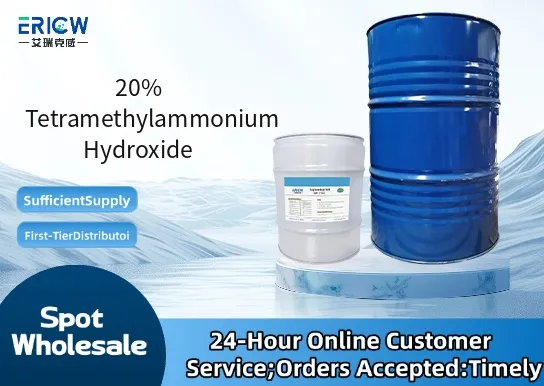
High-purity aqueous solution with consistent 20.0 ± 0.5 wt% concentration for precise process control.
Ultra-low metal ion content (≤10 ppb Na, K, Fe, Ni), critical for semiconductor and microelectronics applications.
Non-volatile, non-oxidizing strong base — safer alternative to alkali metal hydroxides in sensitive etching processes.
Excellent thermal and chemical stability under controlled storage conditions (2–8°C, nitrogen-blanketed).
Readily biodegradable and compatible with standard wastewater neutralization protocols when handled per SDS guidelines.
Photoresist development in advanced lithography (e.g., EUV and DUV patterning for 7 nm–28 nm node IC fabrication).
Controlled silicon anisotropic etching in MEMS and sensor manufacturing (e.g., KOH/TMAH hybrid etch systems).
Surface cleaning and post-etch residue removal for GaN, SiC, and compound semiconductor wafers.
Catalyst preparation and phase-transfer reactions in fine chemical synthesis.
Electrolyte component in specialized electrochemical sensors and fuel cell membrane conditioning.
| Chemical Type | Quaternary ammonium hydroxide |
| Product Form | Aqueous solution (20.0 ± 0.5 wt% TMAH) |
| Appearance | Clear, colorless liquid; no visible particulates or haze |
| pH (25°C, 1:10 dilution) | ≥13.4 |
| Primary Applications | Semiconductor lithography, MEMS etching, precision cleaning |
| Key Features | Low volatility, minimal residue, high selectivity vs. SiO₂/SiNₓ |
| Regulatory Compliance | REACH registered; compliant with RoHS 2015/863 Annex II (excl. exempted substances) |
| Storage Requirement | 2–8°C, protected from CO₂ absorption and light; use within 12 months of opening |
| Common Compatible Systems | Suitability |
| Standard semiconductor wet benches (e.g., Tokyo Electron, SCREEN, Lam Research) | Highly Recommended – Fully validated for resist develop and rinse modules |
| PP (polypropylene) and PVDF fluid handling systems | Highly Recommended – No swelling or leaching observed under continuous flow |
| Stainless steel 316L piping (for short-term transfer only) | Recommended – Requires passivation and strict pH monitoring to prevent pitting |
| Deionized water (DIW) dilution systems | Suitable – Compatible with automated blending up to 0.1–5% working solutions |
Q1: What is the CAS Number for 20% Tetramethylammonium Hydroxide?
A: The CAS Number for tetramethylammonium hydroxide monohydrate (common commercial form) is 75-59-2; the anhydrous base is 10424-65-2. Our 20% solution is supplied as the stable monohydrate form in aqueous medium.
Q2: How does its etch rate compare to KOH or NaOH in silicon processing?
A: At equivalent concentrations and temperatures, 20% TMAH exhibits ~30–40% lower etch rate than 20% KOH on (100) Si, but delivers superior surface smoothness (<0.2 nm RMS), negligible undercut, and higher crystallographic selectivity — especially beneficial for high-aspect-ratio MEMS structures.
Q3: Does TMAH migrate into polymer films or photoresists during development?
A: Minimal migration occurs under standard develop times (<60 s, 23°C). TMAH diffusion into common chemically amplified resists (e.g., AR-P 6200 series) is <5 nm, verified by TOF-SIMS depth profiling — significantly lower than NaOH or TEAH due to its bulky cationic structure.
Q4: Is this product certified for use in ISO 14644-1 Class 1 cleanrooms?
A: Yes — manufactured and packaged in ISO 5 (Class 100) environments; certified particle count ≤1 particle/mL ≥0.2 µm (per ASTM F329); full Certificate of Analysis and Cleanroom Compatibility Report available upon request.
Contact With Us:
E-mail: wangxingqiang@ericwchem.com
Have a Questions? Call Us:
Add:
Building A1, Jiete Industrial Park, Huangpu District, Guangzhou City, Guangdong Province, China