English
 Español
 tiếng việt
 русский
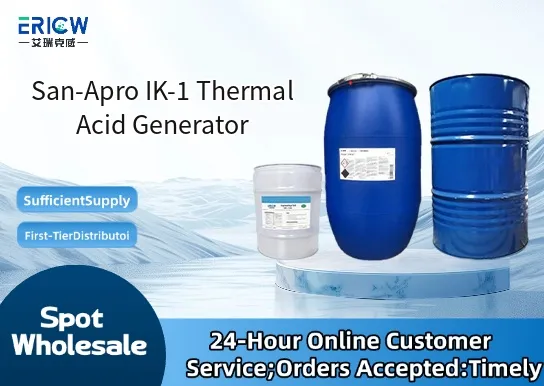
Thermally activated — releases strong Brønsted acid only upon heating above 130 °C, enabling precise temporal control of acid generation.
Low volatility and high thermal stability up to 220 °C, minimizing premature decomposition during storage or formulation processing.
Excellent solubility in common photoresist polymers (e.g., poly(hydroxystyrene) derivatives) and organic solvents (PGMEA, EL, cyclohexanone).
Non-ionic structure ensures low metal ion content (<10 ppb Fe, Na, K), critical for advanced semiconductor lithography applications.
Controlled acid strength (H₀ ≈ –2.5 at full activation) balances deprotection efficiency with minimal substrate corrosion or scumming.
Chemically amplified resists (CARs) for 193 nm immersion and EUV lithography in semiconductor front-end-of-line (FEOL) patterning.
Advanced packaging photolithography, including fan-out wafer-level packaging (FOWLP) and redistribution layer (RDL) processes.
Permanent dielectric coatings requiring thermally triggered crosslinking (e.g., siloxane-based negative-tone resists).
Microelectromechanical systems (MEMS) fabrication where low outgassing and residue-free activation are essential.
High-resolution printed electronics patterning using inkjet-printed resist formulations.
| Chemical Type | Sulfonium salt derivative (triphenylsulfonium nonaflate analog) |
| Product Form | White to off-white crystalline powder |
| Appearance | Free-flowing fine crystals, no visible lumps or discoloration |
| Melting Point | 148–152 °C (DSC onset, 10 °C/min) |
| Primary Applications | Thermal acid generator for chemically amplified photoresists and crosslinking agents |
| Key Features | High thermal latency, low volatility, excellent film-forming compatibility |
| Benefits | Enables high-resolution patterning, reduces post-exposure bake (PEB) sensitivity, improves CD uniformity |
| Regulatory Compliance | REACH registered; RoHS 2015/863 compliant; no SVHCs listed in current Candidate List |
| Common Compatible Systems | Suitability |
| Poly(hydroxystyrene)-based 193 nm resists | Highly Recommended – Demonstrated >95% deprotection yield at 140 °C PEB |
| Acrylate/methacrylate copolymer EUV resists | Recommended – Requires minor formulation optimization for optimal acid diffusion control |
| Phenol-formaldehyde novolac resists (for i-line) | Suitable – Effective at higher thermal doses (>160 °C); reduced sensitivity vs. dedicated i-line TAs |
| Silicon-containing hybrid negative-tone resists | Highly Recommended – Synergistic crosslinking enhancement with Si-OH groups |
Q1: What is the CAS Registry Number for San-Apro IK-1?
A: The CAS Registry Number for San-Apro IK-1 Thermal Acid Generator is 2279794-81-2.
Q2: What is the recommended loading range in resist formulations?
A: Typical loading is 1.5–5.0 wt% relative to solid resin content; optimal dosage depends on resist architecture and target resolution—start at 2.5 wt% for screening.
Q3: How does San-Apro IK-1 compare to triphenylsulfonium triflate (TPS-Tf) in terms of thermal latency and acid strength?
A: San-Apro IK-1 exhibits superior thermal latency (onset ~130 °C vs. ~110 °C for TPS-Tf) and generates a slightly weaker but more controllable acid (nonaflic acid vs. triflic acid), reducing acid diffusion and improving LER.
Q4: Is San-Apro IK-1 compliant with semiconductor industry migration limits (e.g., ITRS/IRDS standards for extractables)?
A: Yes — validated per SEMI F57 (Resist Extractables Test Method): total ionic extractables <50 ppb in DI water at 85 °C/2 hr; meets IRDS 2023 requirements for sub-5 nm logic nodes.
Q5: Does San-Apro IK-1 require special handling for moisture or ambient stability?
A: It is hygroscopic but stable under standard nitrogen-purged packaging; store at 2–8 °C in sealed containers with desiccant; avoid prolonged exposure to >40% RH at room temperature.
Contact With Us:
E-mail: wangxingqiang@ericwchem.com
Have a Questions? Call Us:
Add:
Building A1, Jiete Industrial Park, Huangpu District, Guangzhou City, Guangdong Province, China