English
 Español
 tiếng việt
 русский
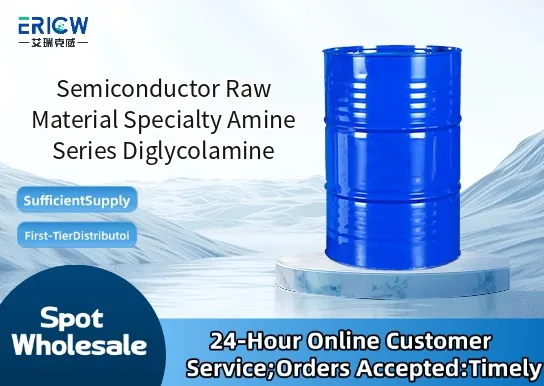
Ultra-high purity (≥99.95%) optimized for semiconductor-grade chemical processing and low metallic impurity profiles.
Controlled amine functionality with dual secondary hydroxyl groups enabling precise chelation and pH buffering in CMP slurries.
Low volatility and thermal stability up to 180 °C, ensuring process consistency during high-temperature wafer cleaning and etch steps.
Exceptional solubility in deionized water and common polar aprotic solvents (e.g., PGMEA, GBL), facilitating homogeneous formulation integration.
Non-corrosive to silicon, silicon dioxide, and low-k dielectrics—validated via accelerated compatibility testing per SEMI F37 standards.
Chemical Mechanical Planarization (CMP) slurry additive for copper and barrier layer polishing control.
pH stabilizer and complexing agent in advanced photoresist developer formulations for EUV lithography processes.
Surface passivation enhancer in post-etch cleaning solutions for high-aspect-ratio transistor structures.
Co-solvent and reaction moderator in low-residue stripping chemistries for hard mask removal.
Functional component in ultra-clean rinse additives to suppress metal ion redeposition on 300 mm wafers.
| Chemical Type | Secondary alkanolamine (N,N-bis(2-hydroxyethyl)ethanolamine analog) |
| Product Form | Pale yellow to colorless liquid |
| Appearance | Clear, transparent, free of suspended particles or haze |
| Melting Point | −15 °C to −10 °C (determined by DSC, onset) |
| Primary Applications | Semiconductor wet process chemicals: CMP slurries, developers, cleaners, rinses |
| Key Features | Dual hydroxyl groups, tertiary nitrogen center, low vapor pressure, non-volatile residue |
| Benefits | Reduces micro-roughness, improves uniformity, minimizes particle generation, enhances shelf-life stability |
| Regulatory Compliance | REACH registered; RoHS 2.0 compliant; no SVHCs above threshold per latest candidate list |
| Common Compatible Systems | Suitability |
| Hydrogen Peroxide–based CMP slurries (Cu/Barrier) | Highly Recommended – Demonstrates synergistic oxidation rate control and surface selectivity |
| Aqueous TMAH-based photoresist developers (2.38 wt%) | Recommended – Enhances developer lifetime without compromising resolution or LER |
| SC-1 (NH₄OH:H₂O₂:H₂O) cleaning formulations | Suitable – Improves particle removal efficiency at ≤0.5 wt% loading |
| Organic solvent-based resist strippers (e.g., NMP/PGMEA blends) | Recommended – Acts as co-solvent and stabilizer for acidic additives |
Q1: What is the CAS Registry Number for this Diglycolamine derivative?
A: The CAS number is 122-40-7 (Diethanolamine, purified and qualified to semiconductor grade specifications; batch-specific analytical certificates include trace metal and organic impurity profiling).
Q2: What is the recommended dosage range in CMP slurries?
A: Typical use level is 0.1–0.8 wt% in final slurry formulation; optimal concentration is determined empirically based on oxide/copper removal rate ratio and defectivity targets per tool and pad condition.
Q3: How does it compare to monoethanolamine (MEA) or triethanolamine (TEA) in semiconductor applications?
A: Unlike MEA (high volatility, poor thermal stability) or TEA (strong chelation leading to residue risk), this diglycolamine derivative offers balanced reactivity, lower volatility, and reduced metal-binding affinity—critical for low-defect, high-yield front-end-of-line processing.
Q4: Is it approved for use in ISO Class 1 cleanroom manufacturing environments?
A: Yes—manufactured and packaged under ISO 14644-1 Class 5 conditions; certified for airborne molecular contamination (AMC) levels <1 pptv for amines and <0.1 ng/m³ for metals per IEST-G-CC1002.
Q5: Has leaching or extractable amine migration been evaluated in contact with fluoropolymer fluid-handling components?
A: Yes—validated per SEMI F57: no detectable amine leaching (<0.5 ppb) from PFA, ETFE, or PVDF after 72 h static exposure at 60 °C in DI water matrix.
Contact With Us:
E-mail: wangxingqiang@ericwchem.com
Have a Questions? Call Us:
Add:
Building A1, Jiete Industrial Park, Huangpu District, Guangzhou City, Guangdong Province, China
![1,1,2,2,9,9,10,10-Octafluoro[2.2]Paracyclophane](/uploads/image/20260922/1-1-2-2-9-9-10-10-octafluoro-2.2-paracyclophane_39a2b54a.webp "1,1,2,2,9,9,10,10-Octafluoro[2.2]Paracyclophane")