English
 Español
 tiếng việt
 русский
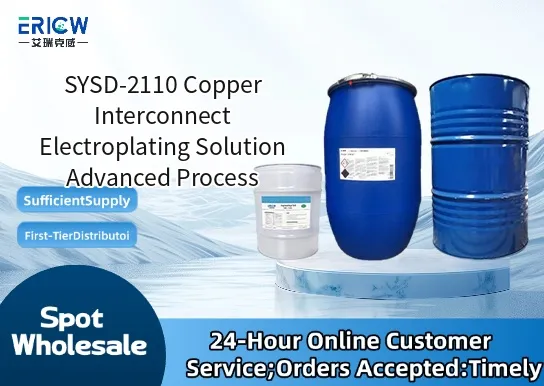
Ultra-low additive consumption enabling extended bath life and reduced operational cost.
Exceptional throwing power for uniform copper deposition in high-aspect-ratio interconnects (≥10:1).
Robust process stability across wide current density range (1–5 A/dm²) with minimal micro-roughness.
Designed for low-defect, void-free filling of sub-22 nm dual-damascene structures.
Compatible with advanced post-plating cleaning chemistries without compromising interface integrity.
Front-end-of-line (FEOL) copper interconnect metallization for logic and memory ICs.
Advanced packaging applications including fan-out wafer-level packaging (FOWLP) and 2.5D/3D TSVs.
High-performance computing (HPC) and AI accelerator chip interconnect fabrication.
RF and millimeter-wave semiconductor devices requiring ultra-low resistivity copper lines.
Next-generation gate-all-around (GAA) transistor interlayer metallization.
| Chemical Type | Aqueous acidic copper sulfate-based electrolyte with proprietary organic additives |
| Product Form | Liquid concentrate (ready-to-dilute) |
| Appearance | Clear, pale blue to light amber solution (pH-adjusted) |
| Primary Applications | Copper electroplating for semiconductor interconnects and advanced packaging |
| Key Features | Low-acid formulation, chloride ion stabilized, non-cyanide, sulfuric acid-based |
| Benefits | Reduced corrosion risk on barrier layers (Ta/TaN), improved electromigration resistance, enhanced via-fill yield |
| Regulatory Compliance | REACH SVHC-free; RoHS 2015/863 compliant; no listed Prop 65 carcinogens |
| Storage Conditions | 15–25 °C, protected from direct sunlight and moisture |
| Common Compatible Systems | Suitability |
| Applied Materials SABRE® G2 / G3 Platforms | Highly Recommended – Validated for full production use with optimized fill performance |
| Lam Research Altus® Max Platform | Highly Recommended – Certified for high-throughput, low-defect Cu fill in sub-20 nm nodes |
| TEL Unity™ i-LINE & e-LINE Tools | Recommended – Requires minor anode configuration adjustment; validated for 28–14 nm nodes |
| SEMES ECP-3000 Series | Suitable – Functional compatibility confirmed; recommended for R&D and pilot-line integration |
Q1: What is the CAS Registry Number for SYSD-2110?
A: SYSD-2110 is a proprietary multi-component formulation and does not have a single CAS number; individual major constituents are documented in the Safety Data Sheet (SDS) Section 3.
Q2: What is the typical working concentration and replenishment rate?
A: Standard operating concentration is 1.5–2.0× dilution of concentrate in deionized water; replenishment is based on ampere-hours (Ah/L), typically 0.8–1.2 mL per Ah of plated copper, monitored via HPLC or CV stripping.
Q3: How does SYSD-2110 compare to legacy copper plating chemistries like ViaForm® or DamasceneFill™?
A: SYSD-2110 delivers superior bottom-up fill at lower current densities, reduced organic decomposition byproducts, and tighter control over grain structure—enabling lower resistivity (1.72 µΩ·cm) and higher thermal stability versus prior-generation formulations.
Q4: Is SYSD-2110 certified for use in ISO 9001 and IATF 16949 manufacturing environments?
A: Yes—SYSD-2110 is manufactured under ISO 9001:2015 and IATF 16949-certified quality systems; lot traceability, analytical release testing, and controlled change management are fully implemented.
Q5: Has migration or leaching of organic additives into low-k dielectrics been evaluated?
A: Yes—accelerated aging studies (150 °C, 96 h) show <0.5 ppm additive diffusion into SiCOH low-k films (k = 2.7), well below industry-defined failure thresholds per JEDEC JEP170.
Contact With Us:
E-mail: wangxingqiang@ericwchem.com
Have a Questions? Call Us:
Add:
Building A1, Jiete Industrial Park, Huangpu District, Guangzhou City, Guangdong Province, China