English
 Español
 tiếng việt
 русский
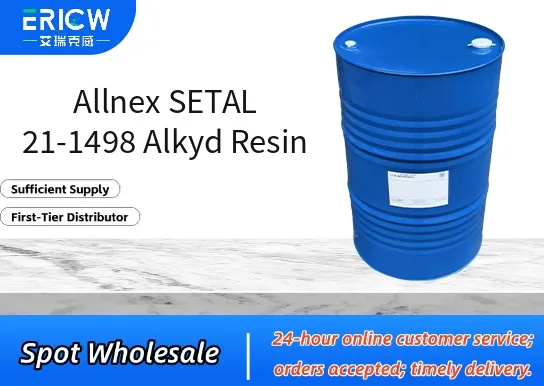
Medium-oil-length alkyd resin based on phthalic anhydride and soybean oil fatty acids.
Designed for excellent through-dry, good hardness development, and balanced flexibility.
Offers superior gloss retention and color stability in air-drying coatings.
Compatible with common hydrocarbon solvents and widely used co-resins including melamines and ureas.
Provides low viscosity for high-solids formulation potential and improved application performance.
General-purpose industrial maintenance coatings (e.g., machinery, agricultural equipment).
Air-drying decorative enamels for metal furniture and household appliances.
Protective primers and topcoats for structural steel and metal substrates.
Low-VOC solventborne wood finishes requiring good flow and leveling.
| Chemical Type | Medium-oil modified phthalic/soybean oil alkyd |
| Product Form | Liquid resin solution |
| Appearance | Clear to slightly hazy, amber-colored liquid |
| Primary Applications | Air-drying industrial enamels, primers, and maintenance coatings |
| Key Features | Good drying speed, gloss retention, flexibility, and compatibility |
| Benefits | Enables high-solids formulations, reduces VOC content, supports consistent film formation |
| Solubility | Compatible with xylene, mineral spirits, and aromatic hydrocarbon blends |
| Storage Stability | Stable under cool, dry conditions; avoid prolonged exposure to moisture or freezing |
Q1: What is the primary application area for SETAL 21-1498?
A: SETAL 21-1498 is a medium-oil-length alkyd resin designed primarily for solvent-based decorative and protective coatings, including interior/exterior architectural paints, wood finishes, and general industrial maintenance coatings where balanced drying performance, gloss retention, and substrate adhesion are required.
Q2: Is SETAL 21-1498 compatible with common co-resins and additives?
A: Yes — it exhibits good compatibility with melamine-formaldehyde resins, urea-formaldehyde resins, and phenolic resins in baked systems, as well as with acrylics and vinyls in ambient-cure blends. It also accepts standard pigment dispersants, rheology modifiers, and driers without significant formulation instability under typical processing conditions.
Q3: How does SETAL 21-1498 perform in terms of drying and film formation?
A: It offers balanced through-dry and surface-dry characteristics, supporting both air-dry and drier-accelerated curing. Films typically develop good hardness and flexibility within 24–48 hours at ambient temperature, with improved crosslink density and chemical resistance upon thermal post-curing.
Q4: Can SETAL 21-1498 be used in low-VOC formulations?
A: While inherently a solvent-borne resin, it can be incorporated into reduced-VOC systems by optimizing solvent blends (e.g., using higher-boiling, lower-vapor-pressure solvents) and combining with reactive diluents or water-reducible hybrids — though full water dispersion requires additional modification not inherent to this grade.
Contact With Us:
E-mail: wangxingqiang@ericwchem.com
Have a Questions? Call Us:
Add:
Building A1, Jiete Industrial Park, Huangpu District, Guangzhou City, Guangdong Province, China