English
 Español
 tiếng việt
 русский
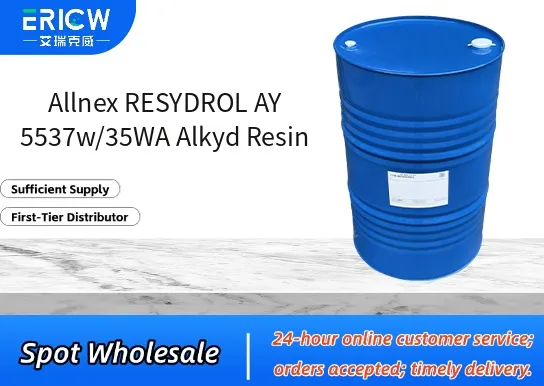
Water-reducible alkyd resin enabling low-VOC, high-performance coatings without co-solvent dependency.
Excellent gloss retention and color stability upon UV exposure and weathering.
Good compatibility with acrylic emulsions, urethane dispersions, and crosslinkers for hybrid systems.
Fast ambient drying with balanced through-cure and film hardness development.
Low odor profile and improved workplace safety versus traditional solvent-borne alkyds.
Architectural interior and exterior waterborne wood finishes (e.g., trim, doors, cabinetry).
Industrial maintenance coatings for metal substrates in mild-to-moderate corrosion environments.
Waterborne varnishes and clearcoats for furniture and flooring applications.
Hybrid waterborne topcoats for general-purpose decorative and protective coatings.
Refinish coatings for DIY and professional wood repair systems.
| Chemical Type | Water-reducible alkyd resin (modified phthalic-based) |
| Product Form | Aqueous dispersion |
| Appearance | Opaque white to off-white liquid |
| pH (25 °C) | 8.0 – 9.0 |
| Solids Content (wt %) | 34.0 – 36.0 |
| Viscosity (Brookfield RVT, #2 spindle, 20 rpm, 25 °C) | 1,500 – 3,500 mPa·s |
| Minimum Film Formation Temperature (MFFT) | ≈ 15 °C |
| Primary Applications | Waterborne wood and metal protective coatings |
Q1: What is the primary application area for RESYDROL AY 5537w/35WA?
A: RESYDROL AY 5537w/35WA is a water-reducible alkyd resin designed primarily for high-performance architectural and industrial maintenance coatings, including interior and exterior satin/matte decorative paints where low VOC, good flow, and balanced drying characteristics are required.
Q2: How does this resin contribute to film formation in waterborne systems?
A: As a self-emulsifiable, water-reducible alkyd, it forms stable dispersions without requiring high levels of external surfactants. It contributes to cohesive, flexible film formation through oxidative crosslinking, supported by coalescence during ambient drying — enabling good scrub resistance and substrate adhesion in low-VOC formulations.
Q3: Can RESYDROL AY 5537w/35WA be blended with acrylic emulsions or other binders?
A: Yes, it is commonly used in hybrid systems with acrylic emulsions to balance cost, performance, and sustainability goals. Compatibility is generally good, though formulation stability and drying behavior should be verified experimentally due to differences in particle morphology and crosslinking mechanisms.
Q4: What type of catalysts or driers are recommended for optimal through-dry?
A: Traditional cobalt-free drier combinations — such as zirconium, calcium, and manganese-based driers — are typically effective. Performance depends on the overall formulation pH, pigment volume concentration, and presence of chelating agents; therefore, drier selection and dosage should be optimized empirically for each system.
Contact With Us:
E-mail: wangxingqiang@ericwchem.com
Have a Questions? Call Us:
Add:
Building A1, Jiete Industrial Park, Huangpu District, Guangzhou City, Guangdong Province, China