English
 Español
 tiếng việt
 русский
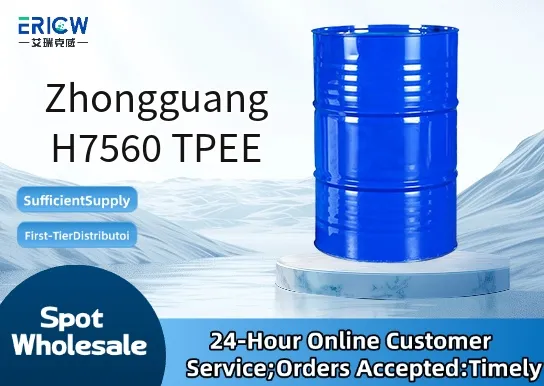
Excellent balance of thermoplastic processability and elastomeric performance.
High tensile strength and outstanding resilience at elevated temperatures.
Good resistance to oils, greases, and common industrial chemicals.
Low compression set for durable sealing and dynamic component applications.
Compatible with injection molding, extrusion, and blow molding processes.
Automotive under-hood components including charge air tubes and sensor housings.
Industrial hoses and fluid handling systems requiring thermal and chemical stability.
High-performance seals, gaskets, and vibration-damping mounts.
Consumer electronics casings and protective overmolded parts.
Medical tubing and non-implantable device components meeting ISO 10993-compatibility requirements.
| Chemical Type | Thermoplastic Polyester Elastomer (TPEE) |
| Product Form | Pellets |
| Appearance | Off-white to light beige granules |
| Primary Applications | Dynamic mechanical parts, seals, hoses, overmolding |
| Key Features | High heat resistance, fatigue resistance, oil resistance |
| Benefits | Reduced part weight vs. thermosets; recyclable processing; consistent melt flow |
| Density (g/cm³) | 1.21–1.24 |
| Melt Flow Rate (230°C/2.16 kg) | 15–22 g/10 min |
Q1: What are the key processing advantages of Zhongguang H7560 TPEE compared to conventional thermoplastic elastomers?
A: Zhongguang H7560 TPEE offers excellent melt processability with low viscosity at typical extrusion and injection molding temperatures, enabling efficient shaping of complex geometries. Its fast crystallization kinetics support shorter cycle times, and it exhibits minimal post-molding shrinkage or warpage under standard processing conditions.
Q2: Is Zhongguang H7560 TPEE suitable for applications requiring repeated flexing and dynamic mechanical stress?
A: Yes — as a polyester-based thermoplastic elastomer, H7560 TPEE delivers outstanding resilience, high tensile strength, and exceptional fatigue resistance. It maintains performance over extended cycles of bending, torsion, and compression, making it well-suited for dynamic components such as drive belts, flexible couplings, and sporting goods parts.
Q3: How does Zhongguang H7560 TPEE perform in environments with exposure to oils, greases, and common industrial fluids?
A: H7560 TPEE demonstrates good resistance to non-polar hydrocarbons, lubricating oils, and many aliphatic solvents due to its semi-crystalline polyester backbone. While not recommended for prolonged immersion in strong polar solvents or chlorinated agents, it retains dimensional stability and mechanical integrity under intermittent contact with typical industrial fluids.
Q4: Can Zhongguang H7560 TPEE be blended or co-processed with other polymers?
A: H7560 TPEE is compatible with several engineering thermoplastics — notably polyesters (e.g., PET, PBT) and certain polyamides — and is often used in reactive or non-reactive blends to tailor stiffness, elasticity, or thermal behavior. Compatibility should be verified experimentally for each specific formulation, as phase morphology and interfacial adhesion influence final properties.
Contact With Us:
E-mail: wangxingqiang@ericwchem.com
Have a Questions? Call Us:
Add:
Building A1, Jiete Industrial Park, Huangpu District, Guangzhou City, Guangdong Province, China