English
 Español
 tiếng việt
 русский
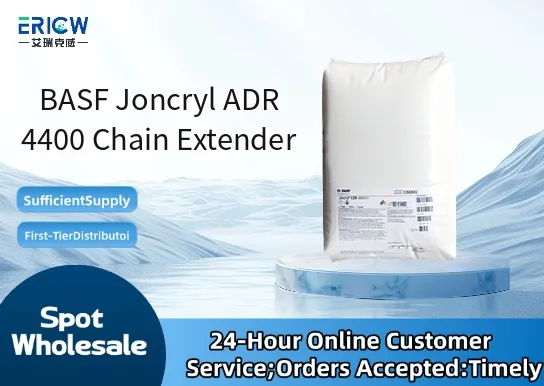
Highly efficient epoxy-functional chain extender for polyesters, polyacrylates, and other hydroxyl- or carboxyl-terminated polymers.
Enables precise molecular weight control and improved melt strength without significant viscosity increase.
Compatible with standard processing equipment; requires no special handling or inert atmosphere.
Delivers excellent thermal and mechanical property enhancement in recycled and virgin polymer systems.
Low volatility and minimal odor — supports safer industrial handling and compliant processing environments.
Enhancement of recycled PET (rPET) for high-performance fiber, sheet, and injection molding applications.
Molecular weight stabilization in polyester-based thermoplastic elastomers (TPEs).
Viscosity and toughness improvement in waterborne acrylic and polyester dispersions.
Chain extension in biodegradable polyesters (e.g., PBA, PBS, PBAT) for film and packaging grades.
Performance upgrade of engineering thermoplastics containing reactive end groups during compounding.
| Chemical Type | Epoxy-functional oligomeric chain extender |
| Product Form | Pellets |
| Appearance | Off-white to light beige, free-flowing pellets |
| Primary Applications | Polyester, polyacrylate, and aliphatic polyester modification |
| Key Features | Reactive epoxy functionality, low dust generation, thermal stability up to 260 °C |
| Benefits | Improved melt strength, enhanced tensile properties, compatibility with recycling streams |
| Storage Conditions | Store in original sealed container at 15–25 °C; protect from moisture |
| Processing Temperature Range | 180–250 °C (dependent on base polymer) |
Q1: What is the primary function of Joncryl ADR 4400 in polymer systems?
A: Joncryl ADR 4400 is a multifunctional epoxy-based chain extender designed to increase molecular weight and improve melt strength, viscosity, and mechanical performance—particularly in recycled or degraded polyesters, polyacrylates, and other condensation polymers.
Q2: Which polymer types are most commonly modified using Joncryl ADR 4400?
A: It is widely used with post-consumer and post-industrial PET, PBT, and PLA—especially in applications where thermal history has reduced molecular weight. It also shows compatibility with certain acrylic dispersions and functionalized polyolefins when tailored for reactive compounding.
Q3: How is Joncryl ADR 4400 typically incorporated into a formulation?
A: It is generally added during melt processing—such as extrusion or injection molding—using standard twin-screw equipment. Pre-blending with polymer flakes or masterbatching is recommended to ensure uniform dispersion prior to high-temperature processing.
Q4: Does Joncryl ADR 4400 require special handling or storage conditions?
A: Yes—it is moisture-sensitive and should be stored in its original sealed container under dry, cool conditions (below 30 °C). Exposure to ambient humidity may cause premature reactivity or clumping, so proper handling in low-humidity environments is advised during processing.
Q5: Can Joncryl ADR 4400 improve the processability of recycled PET blends?
A: Yes—by restoring chain length and enhancing melt elasticity, it helps reduce die swell variation, improves extrudate homogeneity, and supports stable film or fiber spinning in rPET-based systems, especially when combined with appropriate stabilizers.
Contact With Us:
E-mail: wangxingqiang@ericwchem.com
Have a Questions? Call Us:
Add:
Building A1, Jiete Industrial Park, Huangpu District, Guangzhou City, Guangdong Province, China