English
 Español
 tiếng việt
 русский
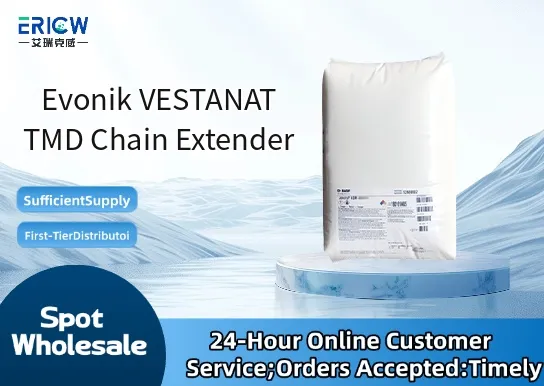
Highly efficient chain extender for aliphatic and aromatic polyurethane elastomers.
Enables excellent mechanical properties including high tensile strength and elongation at break.
Offers superior hydrolytic stability compared to conventional diamine-based extenders.
Provides extended processing window due to controlled reactivity with isocyanates.
Supports low-viscosity formulations, facilitating homogeneous mixing and improved processability.
Thermoplastic polyurethane (TPU) compounds for extrusion and injection molding.
Polyurethane elastomer systems used in automotive bushings and suspension components.
High-performance coatings requiring abrasion resistance and flexibility.
Cast elastomer applications such as industrial rollers, seals, and mining screens.
Adhesives and sealants where balanced cure kinetics and final property development are critical.
| Chemical Type | Aliphatic diamine-based chain extender |
| Product Form | Liquid |
| Appearance | Clear, pale yellow liquid |
| Primary Applications | Polyurethane elastomers, TPUs, coatings, adhesives |
| Key Features | Controlled reactivity, hydrolytic stability, low volatility |
| Benefits | Enhanced mechanical performance, improved processing safety, reduced odor |
| Storage Conditions | Store under nitrogen; protect from moisture and light |
| Handling Precautions | Use in well-ventilated areas; refer to Safety Data Sheet (SDS) |
Q1: What is the primary function of VESTANAT TMD in polyurethane systems?
A: VESTANAT TMD is a trifunctional aliphatic chain extender designed to enhance crosslink density, improve mechanical strength, and increase thermal stability in solventborne and high-solids polyurethane coatings, adhesives, and elastomers.
Q2: How does VESTANAT TMD differ from conventional diamine or diol chain extenders?
A: Unlike typical difunctional extenders, VESTANAT TMD features three reactive amine groups, enabling controlled branching and higher network functionality—resulting in improved hardness, chemical resistance, and reduced sensitivity to stoichiometric imbalance during processing.
Q3: Is VESTANAT TMD compatible with moisture-cure or one-component PU systems?
A: VESTANAT TMD is primarily intended for two-component (2K) aliphatic PU systems where precise stoichiometry and pot life control are critical; its high reactivity and trifunctionality make it unsuitable for standard moisture-cure formulations without significant formulation adaptation and testing.
Q4: What handling precautions should be observed when working with VESTANAT TMD?
A: As with other aliphatic amines, VESTANAT TMD requires handling in well-ventilated areas, using appropriate personal protective equipment (PPE) such as nitrile gloves and safety goggles; avoid prolonged skin contact and inhalation of mists or vapors.
Q5: How does VESTANAT TMD influence pot life and film formation in coating applications?
A: Due to its trifunctional structure and moderate reactivity, VESTANAT TMD offers a balanced pot life suitable for industrial spray application while promoting rapid early-stage network development—supporting good sag resistance and efficient ambient- or forced-dry film formation.
Contact With Us:
E-mail: wangxingqiang@ericwchem.com
Have a Questions? Call Us:
Add:
Building A1, Jiete Industrial Park, Huangpu District, Guangzhou City, Guangdong Province, China