English
 Español
 tiếng việt
 русский
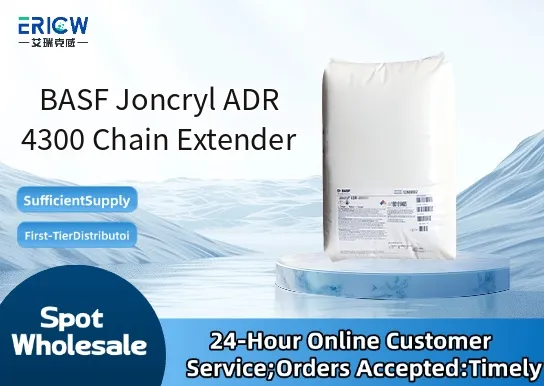
Highly efficient epoxy-functional chain extender for polyesters and polyacrylates.
Enables significant increase in melt viscosity and molecular weight without gelation.
Improves mechanical properties including tensile strength, impact resistance, and thermal stability.
Compatible with standard extrusion and compounding equipment; no special handling required.
Low volatility and excellent thermal stability up to 280 °C processing temperatures.
Recycled PET (rPET) upgrading for food-contact and high-performance packaging.
Engineering thermoplastics modification, especially PBT and PET blends.
Enhancement of biopolymer performance (e.g., PLA, PHA) in injection molding and extrusion.
Functionalization of reactive polymers for automotive interior components.
| Chemical Type | Epoxy-functional acrylic oligomer |
| Product Form | Powder |
| Appearance | White to off-white free-flowing powder |
| Primary Applications | Polyester and polyacrylate chain extension, rPET valorization |
| Key Features | Multi-epoxy functionality, low dust generation, high reactivity |
| Benefits | Improved melt strength, enhanced recyclate performance, reduced degradation during processing |
| Storage Conditions | Store in original sealed container at 15–25 °C, protect from moisture |
Q1: What is the primary function of Joncryl ADR 4300 in polymer systems?
A: Joncryl ADR 4300 is a multifunctional epoxy-based chain extender designed to increase molecular weight and improve melt strength, viscosity, and mechanical performance—particularly in recycled or degraded polyesters, polyacrylates, and other condensation polymers.
Q2: Is Joncryl ADR 4300 compatible with PET, PBT, and PLA resins?
A: Yes, it demonstrates broad compatibility with aromatic and aliphatic polyesters—including PET, PBT, and PLA—and is frequently used to enhance processability and mechanical integrity in post-consumer or industrial polyester recyclates.
Q3: How is Joncryl ADR 4300 typically incorporated into a polymer formulation?
A: It is generally added during melt compounding—either as a neat liquid or pre-dispersed masterbatch—and reacts in situ under standard extrusion conditions without requiring catalysts or extended residence times.
Q4: Does Joncryl ADR 4300 affect thermal stability or color development during processing?
A: When used within recommended dosage ranges, it exhibits good thermal stability up to typical polyester processing temperatures and shows minimal tendency toward yellowing—though optimal results depend on base resin quality and thermal history.
Q5: Can Joncryl ADR 4300 be used alongside other additives such as impact modifiers or nucleating agents?
A: Yes—it is generally compatible with common polymer additives, though interactions should be evaluated case-by-case in final formulations to ensure no antagonistic effects on reactivity or dispersion.
Contact With Us:
E-mail: wangxingqiang@ericwchem.com
Have a Questions? Call Us:
Add:
Building A1, Jiete Industrial Park, Huangpu District, Guangzhou City, Guangdong Province, China