English
 Español
 tiếng việt
 русский
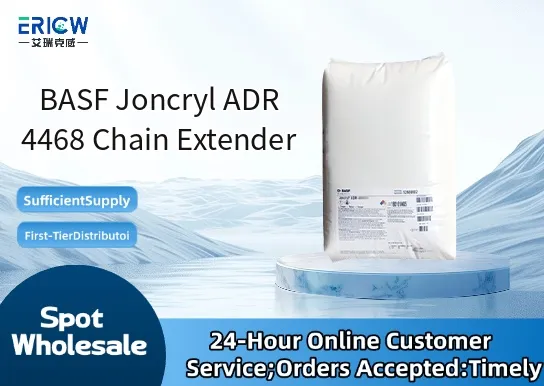
Highly efficient epoxy-functional chain extender for polyesters and polyacrylates.
Enables significant molecular weight build-up with minimal gelation risk.
Improves melt viscosity, mechanical strength, and thermal stability of reactive polymers.
Compatible with conventional processing equipment and standard extrusion or compounding conditions.
Low volatility and excellent thermal stability up to 220 °C during processing.
Recycled PET (rPET) valorization and performance enhancement in fiber and packaging applications.
Chain extension of bio-based polyesters (e.g., PLA, PBS) for improved thermo-mechanical properties.
Modification of reactive hot-melt adhesives to boost cohesive strength and heat resistance.
Stabilization and rheology control of polymer blends containing polar thermoplastics.
| Chemical Type | Epoxy-functional oligomer |
| Product Form | Pale yellow to light amber granules |
| Appearance | Free-flowing, non-dusting granules |
| Primary Applications | Polyester and polyacrylate chain extension, rPET upgrading, reactive compounding |
| Key Features | Epoxy functionality, low color, high thermal stability |
| Benefits | Enhanced melt strength, improved tensile properties, reduced degradation during recycling |
| Storage Conditions | Store in original sealed container at 15–25 °C, protect from moisture |
| Shelf Life | 24 months from date of manufacture under recommended storage conditions |
Q1: What is the primary function of Joncryl ADR 4468 in polymer systems?
A: Joncryl ADR 4468 is a multifunctional epoxy-based chain extender designed to increase molecular weight and improve melt strength, viscosity, and mechanical performance—particularly in recycled or degraded polyesters, polyacrylates, and other condensation polymers.
Q2: Which polymer types is Joncryl ADR 4468 most commonly used with?
A: It is widely applied in PET, PBT, PLA, and acrylic-based resins—especially where post-consumer or post-industrial recycling introduces chain scission. It is also compatible with certain polyurethane dispersions and waterborne acrylic systems requiring enhanced film integrity.
Q3: How is Joncryl ADR 4468 typically incorporated into a formulation?
A: It is generally added during melt compounding or extrusion, either directly to the polymer melt or pre-blended with masterbatch carriers. Due to its reactivity, it should be introduced after thermal stabilization steps to avoid premature side reactions.
Q4: Does Joncryl ADR 4468 affect processing stability or color development?
A: When processed within recommended temperature and residence time windows, it exhibits good thermal stability and minimal yellowing tendency—though prolonged exposure to high shear or excessive temperatures may accelerate discoloration, especially in sensitive resin systems.
Q5: Is Joncryl ADR 4468 suitable for food-contact or regulated applications?
A: Joncryl ADR 4468 is not pre-approved for direct food-contact use under major global regulatory frameworks. Its suitability for such applications depends on full system evaluation—including final formulation, processing conditions, and end-use compliance requirements—and must be confirmed through appropriate regulatory testing and consultation with BASF technical support.
Contact With Us:
E-mail: wangxingqiang@ericwchem.com
Have a Questions? Call Us:
Add:
Building A1, Jiete Industrial Park, Huangpu District, Guangzhou City, Guangdong Province, China