English
 Español
 tiếng việt
 русский
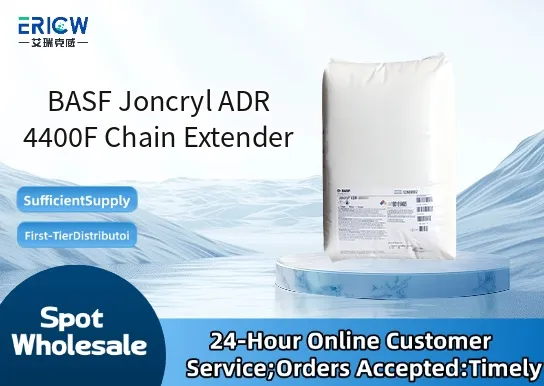
Highly efficient multifunctional epoxy-based chain extender for polyester and polyacrylate resins.
Enables precise molecular weight control and improved melt viscosity without gelation risk.
Compatible with both solvent-borne and waterborne systems, supporting low-VOC formulations.
Enhances mechanical properties including tensile strength, elongation, and impact resistance.
Thermally stable up to 220 °C, suitable for high-temperature extrusion and curing processes.
High-performance powder coatings for architectural and appliance finishes.
Automotive clearcoats and basecoats requiring enhanced durability and scratch resistance.
Industrial maintenance coatings exposed to harsh chemical and weathering conditions.
UV-curable and thermoset inkjet inks for packaging and decorative printing.
Engineering thermoplastics modification, especially recycled PET and PBT reprocessing.
| Chemical Type | Multifunctional epoxy resin |
| Product Form | Free-flowing white to off-white granules |
| Appearance | Granular, non-dusting, free of visible impurities |
| Primary Applications | Chain extension and branching of polyesters, acrylics, and polyurethanes |
| Key Features | Epoxy functionality ≥ 3.8; low volatility; excellent thermal stability |
| Benefits | Improved melt strength, reduced brittleness, enhanced crosslink density |
| Storage Conditions | Store in original sealed container at 5–25 °C, protect from moisture |
| Handling Precautions | Use in well-ventilated area; avoid inhalation of dust and skin contact |
Q1: What is the primary function of Joncryl ADR 4400F in polymer systems?
A: Joncryl ADR 4400F is a multifunctional epoxy-based chain extender designed to increase molecular weight and improve melt strength, viscosity, and mechanical performance—particularly in recycled or degraded polyesters, polyacrylates, and other condensation polymers.
Q2: Which polymer types is Joncryl ADR 4400F most commonly used with?
A: It is widely applied in PET, PBT, PLA, and acrylic resins—especially in post-consumer recycled (PCR) streams where chain scission has reduced molecular weight and processability. Compatibility with polar thermoplastics makes it suitable for compounding and reactive extrusion processes.
Q3: How is Joncryl ADR 4400F typically incorporated into formulations?
A: It is generally added during melt processing—such as twin-screw extrusion—at low concentrations. Dosage depends on formulation requirements and the extent of polymer degradation, but typical usage ranges from 0.1% to 2% by weight relative to the base polymer.
Q4: Does Joncryl ADR 4400F affect thermal stability or color development during processing?
A: When processed within recommended temperature windows and residence times, it exhibits good thermal stability and minimal yellowing tendency. However, prolonged exposure to high temperatures or excessive shear may promote side reactions—so optimized screw design and processing parameters are recommended.
Q5: Can Joncryl ADR 4400F be used in food-contact or medical-grade applications?
A: Joncryl ADR 4400F is not pre-approved for direct food-contact or implantable medical use. Its suitability for regulated applications depends on full system evaluation—including final formulation, processing conditions, and compliance testing—per applicable regional regulatory frameworks.
Contact With Us:
E-mail: wangxingqiang@ericwchem.com
Have a Questions? Call Us:
Add:
Building A1, Jiete Industrial Park, Huangpu District, Guangzhou City, Guangdong Province, China