English
 Español
 tiếng việt
 русский
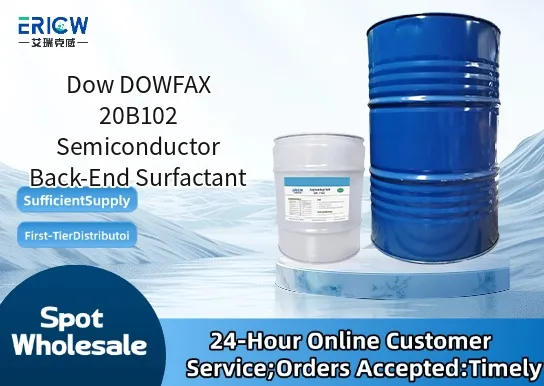
Ultra-low residue formulation engineered specifically for semiconductor back-end cleaning and rinse processes.
Exceptional wetting and surface tension reduction in deionized water at low concentrations (0.01–0.1 wt%).
Nonionic, alkylphenol ethoxylate (APEO)-free chemistry compliant with stringent semiconductor industry purity requirements.
Highly stable in acidic and neutral aqueous chemistries commonly used in wafer-level packaging (WLP) and advanced packaging lines.
Minimal metal ion leaching and ultra-low particle generation—validated per SEMI F57 and JEDEC JESD22-A109 standards.
Post-etch and post-CMP (Chemical Mechanical Planarization) rinse solutions for advanced logic and memory devices.
Wafer-level underfill and molding compound removal pre-bake treatments.
Flip-chip and fan-out wafer-level packaging (FOWLP) substrate cleaning prior to solder reflow.
Residue mitigation in copper pillar and microbump cleaning formulations.
Low-k dielectric surface conditioning during interconnect cleaning steps.
| Chemical Type | Branched alkyl ether sulfate, nonionic–anionic hybrid surfactant |
| Product Form | Aqueous solution (~30% active content) |
| Appearance | Clear, colorless to pale yellow liquid |
| pH (1% aqueous solution, 25°C) | 6.5–7.5 |
| Primary Applications | Semiconductor back-end cleaning, rinse aid, residue suppression |
| Key Features | APEO-free, low sodium, low chloride, low sulfate ash |
| Benefits | Reduces pattern collapse, improves drying uniformity, minimizes watermarking |
| Regulatory Compliance | REACH registered; RoHS 2015/863 compliant; no SVHCs above 0.1% w/w |
| Common Compatible Systems | Suitability |
| Deionized Water (DIW) Rinse Systems | Highly Recommended – Optimized for low-concentration addition (10–100 ppm) with rapid drainage and minimal foaming |
| Acidic Citric/Nitric-Based Cleaners (pH 2–4) | Recommended – Stable for ≤15 min exposure; validated in inline spray and immersion tools |
| Neutral Organic Solvent-Water Blends (e.g., PGMEA/H₂O) | Suitable – Partial miscibility; requires pre-mix validation for phase stability |
| Standard Spin-Rinse-Dry (SRD) Tools (e.g., Tokyo Electron, Lam Research) | Highly Recommended – Verified compatibility with TEL ACT series and Lam’s Stream™ platforms |
Q1: What is the CAS Registry Number for DOWFAX 20B102?
A: The CAS number is 1337915-02-9. This identifier applies to the proprietary branched alkyl ether sulfate composition as supplied in aqueous form.
Q2: What is the recommended dosage range in DIW rinse applications?
A: Typical use level is 10–100 ppm (0.001–0.01 wt%) in final rinse tanks; optimal concentration is process- and tool-specific and should be determined via DOE with surface contact angle and particle count verification.
Q3: How does DOWFAX 20B102 compare to traditional linear alcohol ethoxylates (e.g., DOWFAX 8390) in back-end applications?
A: Unlike linear analogues, 20B102 offers superior low-temperature solubility, reduced micelle-driven residue deposition on hydrophobic low-k surfaces, and lower critical micelle concentration (CMC) — enabling effective performance at sub-50 ppm dosing.
Q4: Is DOWFAX 20B102 subject to extractables or leachables concerns in high-purity rinse environments?
A: Extractables testing per USP <788> and SEMI F57 confirms <0.5 ppb total organic carbon (TOC) leachables after 24-hr static soak in 18.2 MΩ·cm DIW at 25°C — well below industry thresholds for advanced node manufacturing.
Q5: Does DOWFAX 20B102 require special handling or storage conditions?
A: Store at 5–30°C in original sealed container; avoid freezing and prolonged exposure to UV light. No special PPE beyond standard lab gloves and eye protection is required per SDS Section 8.
Contact With Us:
E-mail: wangxingqiang@ericwchem.com
Have a Questions? Call Us:
Add:
Building A1, Jiete Industrial Park, Huangpu District, Guangzhou City, Guangdong Province, China