English
 Español
 tiếng việt
 русский
Highly selective for deep desulfurization of naphtha and reformate streams.
Thermally stable under continuous operation at elevated temperatures up to 400 °C.
Resistant to nitrogen and olefin poisoning, ensuring extended catalyst life.
Low-pressure operation capability (1–30 bar), reducing energy consumption and equipment cost.
Customizable pellet geometry and pore structure for optimized mass transfer and pressure drop control.
Gasoline sulfur reduction in hydrotreating units prior to catalytic reforming.
Naphtha pretreatment for platinum-based reforming catalysts.
Production of ultra-low-sulfur gasoline (ULSG) meeting Tier 3 and Euro 6 specifications.
Refinery integration with selective hydrodesulfurization (HDS) and hydrodenitrogenation (HDN) processes.
Feed purification for aromatic extraction and isomerization units.
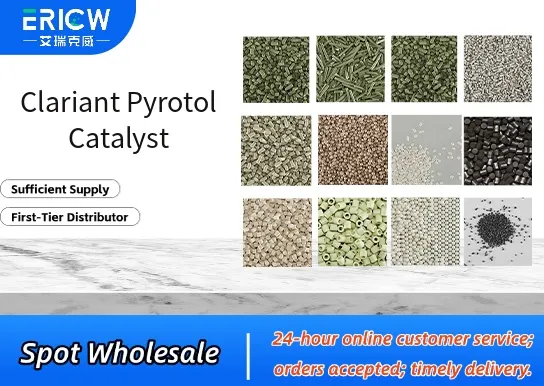
| Chemical Type | CoMo/Al₂O₃-based sulfided hydrotreating catalyst |
| Product Form | Cylindrical extrudates (1.6–3.2 mm diameter) |
| Appearance | Black, free-flowing granular solid |
| Primary Applications | Naphtha desulfurization, reformer feed pretreatment |
| Key Features | High sulfur capacity, low hydrogen consumption, robust poison resistance |
| Benefits | Extended run lengths, reduced regeneration frequency, improved product quality |
| Storage Requirement | Store in dry, well-ventilated area; avoid exposure to moisture and air |
Q1: What is the primary function of Pyrotol Catalyst in polymer processing?
A: Pyrotol Catalyst is a high-performance thermal catalyst designed to accelerate controlled crosslinking and curing reactions—particularly in peroxide-initiated systems for thermoset resins, elastomers, and specialty polymers. It enhances reaction efficiency and improves final product consistency without compromising thermal stability.
Q2: Is Pyrotol Catalyst compatible with common peroxides used in rubber and composite manufacturing?
A: Yes, Pyrotol Catalyst is formulated for synergistic performance with a broad range of organic peroxides—including dicumyl peroxide, di-tert-butyl peroxide, and benzoyl peroxide—enabling optimized scorch safety, cure rate, and network uniformity across diverse elastomeric and thermosetting formulations.
Q3: How should Pyrotol Catalyst be handled and stored to maintain its activity?
A: Store in original sealed packaging under cool, dry conditions away from direct sunlight, moisture, and strong oxidizing agents. Avoid prolonged exposure to elevated temperatures or humid environments, as these may affect catalytic performance over time. Always follow standard industrial hygiene practices during handling.
Q4: Can Pyrotol Catalyst be used in food-contact or medical-grade polymer applications?
A: Pyrotol Catalyst is not pre-qualified for direct food-contact or implantable medical applications. Its suitability for regulated end uses must be evaluated case by case, including full formulation testing and compliance verification with applicable regional regulatory frameworks.
Contact With Us:
E-mail: wangxingqiang@ericwchem.com
Have a Questions? Call Us:
Add:
Building A1, Jiete Industrial Park, Huangpu District, Guangzhou City, Guangdong Province, China