English
 Español
 tiếng việt
 русский
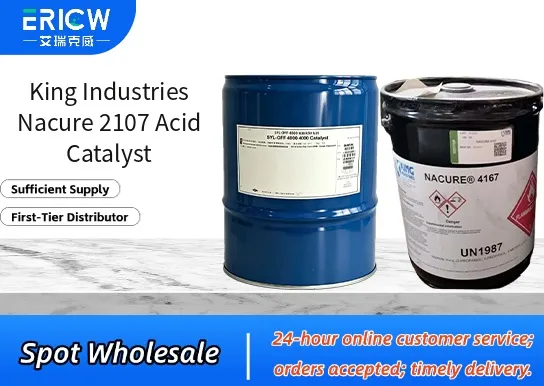
Highly effective low-temperature curing catalyst for amino-formaldehyde resins.
Offers excellent shelf stability in solvent-based and high-solids coating formulations.
Delivers balanced reactivity—fast cure initiation without premature gelation.
Compatible with melamine, urea, and benzoguanamine crosslinkers in industrial coatings.
Low volatility and reduced odor profile compared to traditional strong acid catalysts.
Automotive OEM and refinish coil coatings.
Industrial wood finishes requiring rapid through-cure and hardness development.
Metal packaging coatings (e.g., food-can interiors and aerosol cans).
General-purpose appliance and furniture coatings based on melamine-modified alkyds or acrylics.
High-performance powder coating systems utilizing amino resins.
| Chemical Type | Encapsulated organic sulfonic acid derivative |
| Product Form | Liquid |
| Appearance | Clear, pale yellow liquid |
| Primary Applications | Amino resin crosslinking in thermosetting coatings |
| Key Features | Latent acidity, thermal activation onset ~120°C |
| Benefits | Improved pot life, reduced film defects, enhanced edge coverage |
| Solubility | Compatible with common organic solvents (e.g., xylene, butyl acetate, PGMEA) |
| Storage Conditions | Store at 15–25°C in tightly sealed containers; protect from moisture |
Q1: What is the primary function of Nacure 2107 in coating and ink formulations?
A: Nacure 2107 is a latent acid catalyst designed to promote efficient thermal crosslinking of acid-curable resins—particularly melamine-formaldehyde and urea-formaldehyde systems—in thermosetting coatings, inks, and adhesives. It remains inactive at ambient temperatures and activates upon heating, enabling controlled cure onset and improved pot life.
Q2: How does Nacure 2107 compare to traditional strong mineral acid catalysts in terms of handling and stability?
A: Unlike volatile or corrosive mineral acids (e.g., p-toluenesulfonic acid), Nacure 2107 offers enhanced storage stability, lower volatility, and reduced risk of premature reaction or resin degradation. Its latent nature supports safer handling, longer formulation shelf life, and better compatibility with sensitive components such as pigments and rheology modifiers.
Q3: Is Nacure 2107 compatible with waterborne systems?
A: Yes, Nacure 2107 demonstrates good compatibility with many waterborne acrylic, polyester, and hybrid resin systems. It can be incorporated directly or via pre-dispersion, though optimal performance depends on pH, co-solvent selection, and emulsion stability—formulation testing is recommended to confirm compatibility and cure response.
Q4: What is the typical dosage range for effective catalysis?
A: Dosage is formulation-dependent, but Nacure 2107 is typically used at low concentrations—generally ranging from 0.1% to 2% by weight relative to total resin solids. Optimal levels should be determined empirically based on desired cure speed, film properties, and thermal profile.
Q5: Can Nacure 2107 be used in food-contact or industrial maintenance coatings?
A: Nacure 2107 is intended for industrial and protective coating applications where regulatory compliance is determined by the full formulation—not individual ingredients. Users must evaluate final product compliance with applicable food-contact regulations, VOC limits, and end-use requirements through qualified testing and consultation with regulatory experts.
Contact With Us:
E-mail: wangxingqiang@ericwchem.com
Have a Questions? Call Us:
Add:
Building A1, Jiete Industrial Park, Huangpu District, Guangzhou City, Guangdong Province, China