English
 Español
 tiếng việt
 русский
High thermal stability with glass transition temperature (Tg) exceeding 170 °C after full curing.
Excellent chemical resistance to acids, alkalis, and solvents in harsh industrial environments.
Superior electrical insulation properties, ideal for high-reliability electronic encapsulation.
Low ionic impurity content, minimizing risk of electrochemical migration in microelectronic applications.
Good adhesion to copper, ceramic, and FR-4 substrates without requiring specialized primers.
Encapsulation and molding compounds for semiconductor devices (e.g., ICs, power modules).
Underfill materials for flip-chip and CSP (chip-scale package) interconnects.
Die-attach adhesives in high-power LED and automotive electronics assemblies.
Matrix resin in high-performance prepregs for aerospace-grade laminates.
Electrical potting compounds for transformers, sensors, and high-voltage connectors.
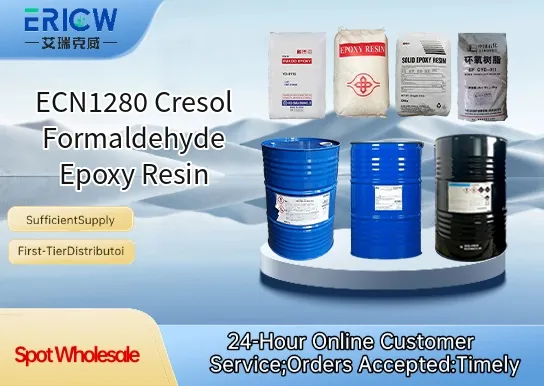
| Chemical Type | Cresol-formaldehyde novolac epoxy resin |
| Product Form | Pale yellow to amber solid pellets or flakes |
| Appearance | Free-flowing, homogeneous granules; no visible foreign particles |
| Epoxy Equivalent Weight (EEW) | 190–210 g/eq |
| Melting Point | 85–95 °C |
| Softening Point | 80–90 °C (ring-and-ball method) |
| Chlorine Content | ≤ 300 ppm |
| Volatiles Content | ≤ 0.3 wt% (at 150 °C, 2 hrs) |
Q1: What are the key performance advantages of ECN1280 compared to standard bisphenol-A epoxy resins?
A: ECN1280 offers significantly higher glass transition temperature (Tg) and improved thermal stability due to its rigid cresol-formaldehyde novolac backbone. It also delivers superior chemical resistance—particularly to acids, solvents, and elevated-temperature environments—making it well-suited for demanding protective coatings and high-performance composites.
Q2: How is ECN1280 typically cured, and what types of hardeners are compatible?
A: ECN1280 is generally cured with aromatic amines (e.g., DDS, DDM) or anhydrides (e.g., HHPA, MTHPA) under elevated temperature conditions. Its high functionality enables robust crosslinking density; cure schedules must be optimized to ensure full conversion while minimizing residual stress in thick-section applications.
Q3: Is ECN1280 suitable for electronic encapsulation or molding compounds?
A: Yes—ECN1280 is widely used in high-reliability electronic encapsulants and transfer-molding compounds where exceptional dielectric strength, low moisture absorption, and long-term thermal aging resistance are required. Its low ionic impurity profile supports stable electrical performance in humid or elevated-temperature service conditions.
Q4: What handling and storage precautions should be observed for ECN1280?
A: ECN1280 should be stored in tightly sealed containers under dry, cool conditions (below 30°C) and protected from moisture and direct sunlight. Prolonged exposure to humidity may lead to viscosity increase or gelation. As with all epoxy resins, appropriate personal protective equipment—including gloves and eye protection—is recommended during handling.
Contact With Us:
E-mail: wangxingqiang@ericwchem.com
Have a Questions? Call Us:
Add:
Building A1, Jiete Industrial Park, Huangpu District, Guangzhou City, Guangdong Province, China