English
 Español
 tiếng việt
 русский
Exceptional lightfastness and weather resistance suitable for demanding outdoor applications.
High thermal stability enabling safe processing in high-temperature polymer systems.
Excellent dispersion performance in both polar and non-polar media.
Strong chromatic strength with clean, bluish-red shade and high tinting power.
Good chemical resistance to acids, alkalis, and solvents under standard processing conditions.
Automotive coatings requiring long-term durability and gloss retention.
Engineering plastics including polyolefins, ABS, and polycarbonate.
Industrial coil coatings exposed to UV and environmental stress.
High-performance inks for packaging and security printing.
Specialty masterbatches for premium-grade colored plastic components.
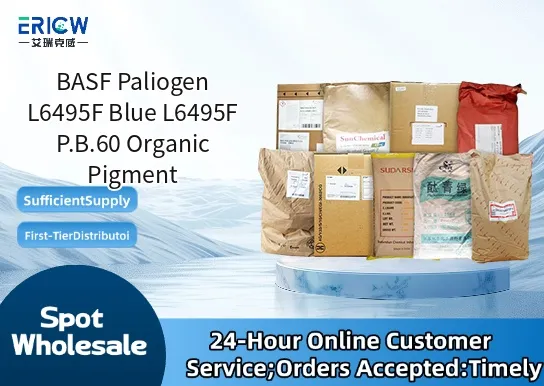
| Chemical Type | Pigment Blue 60 (PB60), perylene derivative |
| Product Form | Fine powder |
| Appearance | Dark blue-violet crystalline powder |
| Primary Applications | Coatings, plastics, and high-end inks |
| Key Features | Lightfastness ≥7 (ISO 105-B02), Weather resistance ≥5 (DIN EN ISO 11341) |
| Thermal Stability | Up to 300 °C (short-term, air atmosphere) |
| Particle Size (D50) | Approx. 0.08–0.12 µm |
| Specific Surface Area | 45–55 m²/g |
Q1: What are the key performance advantages of Paliogen L6495F compared to conventional phthalocyanine blues?
A: Paliogen L6495F offers significantly improved heat stability and lightfastness, enabling reliable performance in high-temperature processing such as engineering plastic compounding and powder coating curing. Its molecular structure provides enhanced resistance to thermal degradation while maintaining excellent chromatic strength and clean blue shade.
Q2: Is Paliogen L6495F suitable for use in automotive coatings?
A: Yes — it is widely used in high-performance automotive basecoats and clearcoat systems where exceptional weathering resistance, gloss retention, and long-term color stability are required. Its robust chemical structure supports compatibility with common acrylic and polyester resin systems used in OEM and refinish applications.
Q3: How does Paliogen L6495F perform in polymer masterbatches, particularly for polyolefins?
A: It demonstrates excellent dispersion stability and minimal plate-out during extrusion, making it well-suited for PP and PE masterbatches. Typical dosage depends on formulation requirements but generally ranges from 0.1% to 2% by weight to achieve full opacity and consistent hue without compromising melt flow or mechanical properties.
Q4: Can this pigment be used in food-contact plastics?
A: Paliogen L6495F is not certified for direct food-contact applications under current global regulatory frameworks. It is intended for industrial and decorative uses only; customers requiring food-safe colorants should consult BASF’s portfolio of approved pigments and obtain appropriate regulatory documentation prior to use.
Contact With Us:
E-mail: wangxingqiang@ericwchem.com
Have a Questions? Call Us:
Add:
Building A1, Jiete Industrial Park, Huangpu District, Guangzhou City, Guangdong Province, China