English
 Español
 tiếng việt
 русский
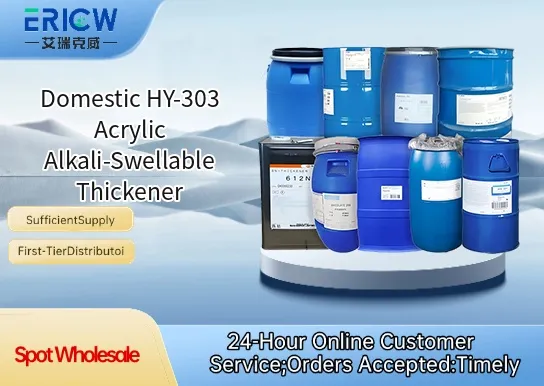
High-efficiency viscosity build-up in alkaline aqueous systems upon pH adjustment.
Excellent shear-thinning rheology for improved application performance and sag resistance.
Good compatibility with anionic surfactants, co-solvents, and common water-based formulation ingredients.
Stable thickening effect across a wide temperature range (5–40°C) without significant viscosity loss.
Low odor and non-toxic profile, supporting safer handling and compliance with industrial hygiene standards.
Architectural interior and exterior latex paints.
Water-based wood coatings and primers.
Industrial maintenance coatings and anti-corrosion paints.
Tile grout and cementitious waterproofing slurries.
Textile printing pastes requiring controlled flow and screen stability.
| Chemical Type | Acrylic acid-based alkali-swellable emulsion polymer |
| Product Form | White to off-white viscous liquid |
| Appearance | Opaque, homogeneous dispersion |
| Active Content (wt%) | 28–32% |
| pH (as supplied) | 2.5–4.0 |
| Viscosity (Brookfield RVT, 2% in 10% NaOH, 25°C) | 8,000–12,000 mPa·s |
| Minimum Film Formation Temperature (MFFT) | Below 0°C |
| Storage Stability (25°C, sealed container) | ≥12 months |
Q1: What is the primary mechanism of thickening for HY-303?
A: HY-303 is an acrylic-based, alkali-swellable associative thickener that functions by expanding and forming a three-dimensional network when neutralized with alkaline agents (e.g., AMP-95, NaOH, or TEA), significantly increasing viscosity in aqueous systems.
Q2: Is HY-303 compatible with common surfactants and co-thickeners used in architectural coatings?
A: Yes — HY-303 demonstrates good compatibility with nonionic and anionic surfactants, as well as with cellulosic thickeners and hydrophobically modified ethoxylated urethanes (HEURs), enabling synergistic rheology control in waterborne paint formulations.
Q3: How should HY-303 be incorporated into a formulation to ensure optimal performance?
A: It is recommended to pre-dilute HY-303 in deionized water (typically at 10–20% solids) and adjust pH to ≥8.0 prior to addition; then incorporate gradually under moderate shear to avoid localized over-neutralization and ensure uniform dispersion.
Q4: Does HY-303 offer any advantages in terms of spatter resistance and sag resistance compared to traditional thickeners?
A: Yes — its associative nature imparts strong pseudoplastic behavior and high low-shear viscosity, which helps improve spatter resistance during roller application and enhances sag resistance on vertical surfaces without compromising flow and leveling.
Q5: Can HY-303 be used in low-VOC or zero-VOC formulations?
A: Yes — HY-303 is inherently low-VOC and contains no APEOs or formaldehyde donors, making it suitable for formulating compliant low- and zero-VOC architectural and industrial coatings.
Contact With Us:
E-mail: wangxingqiang@ericwchem.com
Have a Questions? Call Us:
Add:
Building A1, Jiete Industrial Park, Huangpu District, Guangzhou City, Guangdong Province, China