English
 Español
 tiếng việt
 русский
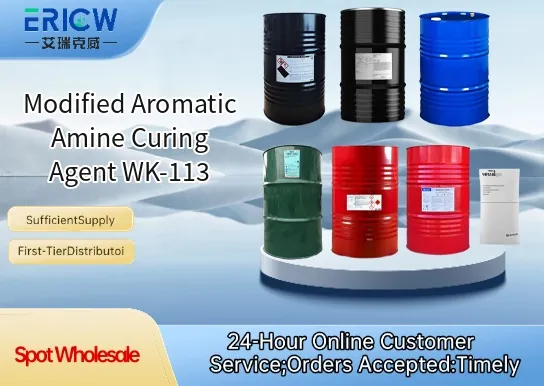
Enhanced low-temperature reactivity for efficient curing at ambient to sub-ambient conditions.
Improved hydrolytic stability compared to conventional aromatic amines, reducing sensitivity to moisture during handling.
Low viscosity and excellent compatibility with standard epoxy resins, enabling homogeneous blending without solvent assistance.
Reduced volatility and amine odor, contributing to safer workplace handling and improved operator comfort.
Delivers high glass transition temperature (Tg) and superior mechanical strength in cured epoxy systems.
Structural adhesives for aerospace and automotive composite bonding.
High-performance coatings for offshore and industrial steel protection.
Electrical encapsulation and potting compounds requiring thermal and dielectric reliability.
Wind turbine blade adhesive joints and structural matrix formulations.
Precast concrete repair mortars and polymer-modified grouts.
| Chemical Type | Modified aromatic polyamine |
| Product Form | Liquid |
| Appearance | Clear to pale amber, homogeneous liquid |
| Primary Applications | Epoxy resin curing agent for structural composites and protective coatings |
| Key Features | Low-temperature cure capability, low volatility, high Tg promotion |
| Benefits | Improved processing safety, extended pot life vs. unmodified amines, enhanced interfacial adhesion |
| Density (25°C) | 1.08–1.12 g/cm³ |
| Amine Value | 380–420 mg KOH/g |
Q1: What are the key advantages of WK-113 compared to conventional aromatic amine curing agents?
A: WK-113 offers improved handling safety and reduced volatility due to its modified molecular structure, while retaining strong reactivity with epoxy resins. It typically delivers enhanced flexibility and impact resistance in cured systems without sacrificing thermal stability or chemical resistance.
Q2: Is WK-113 suitable for ambient-cure epoxy formulations?
A: Yes — WK-113 is specifically designed for ambient- and low-temperature-cure applications. It provides reliable gel time and full cure development at room temperature, though post-cure may be applied to further optimize mechanical and thermal performance.
Q3: How does WK-113 affect pot life and viscosity in epoxy blends?
A: WK-113 generally extends working time relative to unmodified aromatic amines, offering more controllable pot life under standard processing conditions. Its compatibility with common epoxy resins helps maintain manageable blend viscosity without requiring excessive diluents.
Q4: Can WK-113 be used in coatings requiring FDA-compliant cured films?
A: WK-113 is not pre-certified for direct food-contact applications. Formulators must validate final cured film compliance through appropriate testing and regulatory consultation, as suitability depends on the full formulation, cure conditions, and end-use requirements.
Q5: What storage conditions are recommended for optimal shelf life?
A: Store WK-113 in tightly sealed containers under dry, cool conditions (below 30 °C) and protected from moisture and direct sunlight. Under these conditions, it typically maintains stability for up to 12 months from the date of manufacture.
Contact With Us:
E-mail: wangxingqiang@ericwchem.com
Have a Questions? Call Us:
Add:
Building A1, Jiete Industrial Park, Huangpu District, Guangzhou City, Guangdong Province, China