English
 Español
 tiếng việt
 русский
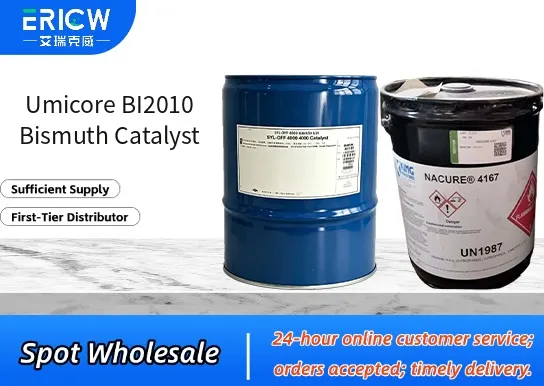
Highly selective bismuth-based catalyst optimized for low-temperature oxidation reactions.
Thermally stable formulation enabling consistent performance across extended operational cycles.
Low volatility and minimal leaching, ensuring long-term catalytic integrity in continuous processes.
Environmentally compatible design with reduced heavy metal migration risk compared to traditional cobalt or lead alternatives.
Engineered for easy integration into existing fixed-bed or slurry-phase reactor systems.
Selective oxidation of propylene to acrolein in acrylic acid production.
Catalytic dehydration and oxidation steps in fine chemical synthesis (e.g., aldehyde and ketone intermediates).
Green oxidation processes for pharmaceutical active ingredient (API) manufacturing.
Upstream catalysis in bio-based monomer production, including glycerol and lactic acid derivatives.
Environmental catalysis for controlled VOC abatement in industrial exhaust streams.
| Chemical Type | Bismuth molybdate-based mixed oxide catalyst |
| Product Form | Granular pellets (typical diameter: 3–5 mm) |
| Appearance | Grayish-black free-flowing granules |
| Primary Applications | Propylene partial oxidation, selective aldehyde synthesis, green oxidation chemistry |
| Key Features | High bismuth dispersion, acid-base balanced surface, tailored pore structure |
| Benefits | Enhanced selectivity, extended catalyst lifetime, lower operating temperature window |
| Storage Conditions | Store in dry, cool environment; avoid prolonged exposure to humidity |
| Handling Precautions | Use appropriate PPE; avoid inhalation of dust during handling |
Q1: What is the primary function of Umicore BI2010 in polyurethane systems?
A: Umicore BI2010 is a bismuth-based catalyst designed to promote urethane bond formation while offering significantly reduced toxicity and environmental impact compared to traditional tin-based alternatives such as DBTDL. It provides balanced reactivity for gelation and surface cure in flexible and rigid foams, coatings, and adhesives.
Q2: Is Umicore BI2010 compatible with common polyurethane raw materials?
A: Yes — BI2010 demonstrates good compatibility with standard polyols (including polyester and polyether types), isocyanates (e.g., MDI and TDI derivatives), and typical formulation additives. It does not typically cause premature gelling or phase separation when incorporated using standard mixing protocols.
Q3: How should Umicore BI2010 be handled and stored?
A: BI2010 should be stored in its original sealed container under dry, cool conditions (preferably below 30 °C) and protected from moisture and direct sunlight. It is supplied as a clear to pale yellow liquid and is non-volatile; standard industrial handling practices for metal carboxylates apply. Personal protective equipment (PPE) appropriate for chemical handling is recommended during transfer and dosing.
Q4: Can Umicore BI2010 replace tin catalysts one-to-one in existing formulations?
A: While BI2010 is formulated as a functional alternative to dibutyltin dilaurate (DBTDL), direct one-to-one substitution may require minor optimization. Its catalytic profile differs in selectivity and reaction onset temperature, so fine-tuning of dosage — typically ranging from 0.1% to 2% by weight relative to polyol — and adjustment of processing parameters (e.g., mix time, demold temperature) are often beneficial to achieve equivalent performance.
Contact With Us:
E-mail: wangxingqiang@ericwchem.com
Have a Questions? Call Us:
Add:
Building A1, Jiete Industrial Park, Huangpu District, Guangzhou City, Guangdong Province, China