English
 Español
 tiếng việt
 русский
Low-VOC, environmentally compliant formulation meeting global regulatory requirements for waterborne coatings.
Excellent film-forming ability with balanced hardness and flexibility at ambient curing conditions.
Superior hydrolytic stability and long pot life in aqueous dispersions, supporting extended storage and processing windows.
Good compatibility with acrylic emulsions, cellulose derivatives, and common co-solvents used in industrial coating systems.
Enhanced adhesion to diverse substrates including plastics, metals, and treated wood without mandatory priming.
Waterborne wood coatings for furniture, flooring, and interior millwork.
High-performance industrial maintenance coatings for metal components and equipment.
Leather finishing topcoats requiring abrasion resistance and soft hand feel.
Flexible packaging coatings where low migration and FDA-compliant contact safety are critical.
Automotive interior trim coatings demanding low odor and VOC compliance.
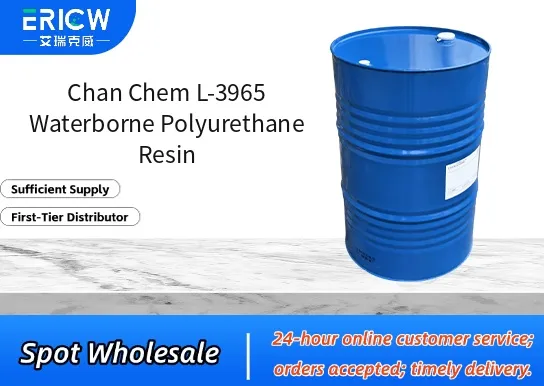
| Chemical Type | Anionic aliphatic polyurethane dispersion |
| Product Form | Opaque white to light yellow aqueous dispersion |
| Appearance | Homogeneous liquid, free of gel particles or sediment |
| Solids Content (wt%) | 30.0 ± 1.5% |
| pH (at 25°C) | 7.8 – 8.5 |
| Viscosity (mPa·s, Brookfield RVT, #2 spindle, 20 rpm) | 150 – 400 |
| Particle Size (D50, nm) | 80 – 120 |
| Minimum Film Formation Temperature (MFFT) | 12 – 15°C |
Q1: What are the primary application areas for L-3965?
A: L-3965 is widely used in high-performance waterborne coatings for flexible substrates, including synthetic leather finishing, textile coatings, and soft-touch automotive interior trim. Its excellent film flexibility, abrasion resistance, and low-temperature performance make it especially suitable for applications requiring dynamic mechanical durability.
Q2: How does L-3965 compare to solvent-based polyurethane resins in terms of film properties?
A: L-3965 delivers film properties—such as tensile strength, elongation, and chemical resistance—that closely approach those of conventional solvent-based systems, while eliminating VOC emissions during processing. It forms coherent, non-tacky films with good intercoat adhesion and enhanced hydrolytic stability under ambient drying conditions.
Q3: Can L-3965 be crosslinked with external agents to enhance performance?
A: Yes, L-3965 is compatible with common water-dispersible crosslinkers such as aziridine, carbodiimide, or blocked polyisocyanate types. Crosslinking improves scrub resistance, solvent resistance, and thermal stability—particularly beneficial for demanding industrial coating formulations.
Q4: What is the recommended pH range for formulating with L-3965?
A: For optimal stability and compatibility, maintain formulation pH between 7.5 and 9.0. Significant deviation—especially below pH 7—may induce viscosity changes or destabilization due to protonation of ionic stabilizing groups.
Contact With Us:
E-mail: wangxingqiang@ericwchem.com
Have a Questions? Call Us:
Add:
Building A1, Jiete Industrial Park, Huangpu District, Guangzhou City, Guangdong Province, China