English
 Español
 tiếng việt
 русский
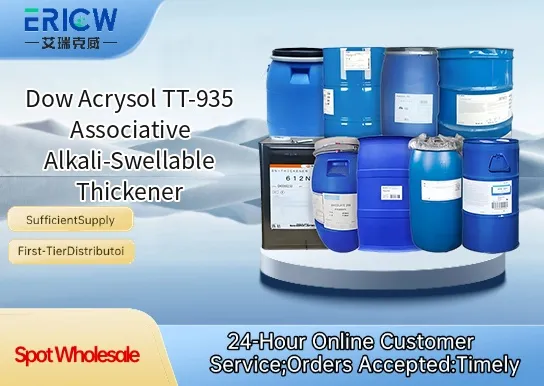
Delivers high-shear viscosity stability in waterborne coatings and architectural paints.
Provides excellent sag resistance and leveling balance without compromising flow properties.
Offers robust rheology control across a broad pH range (pH 7–10), activated by common alkali builders.
Enables low-odor, low-VOC formulations compatible with acrylic and vinyl acetate-based systems.
Delivers outstanding compatibility with surfactants, coalescents, and pigment dispersants.
Interior and exterior architectural latex paints.
Textured coatings and decorative finishes.
Waterborne primers and undercoats.
Low-VOC and zero-VOC paint formulations.
Industrial maintenance coatings for non-critical substrates.
| Chemical Type | Associative alkali-swellable acrylic copolymer |
| Product Form | Aqueous dispersion (40% active) |
| Appearance | Opaque white liquid |
| pH (as supplied) | 2.5–4.0 |
| Viscosity (Brookfield RVT, spindle #3, 20 rpm, 25°C) | 500–1,500 cP |
| Minimum Film Formation Temperature (MFFT) | ~20°C |
| Primary Applications | Architectural coatings, waterborne industrial coatings |
| Key Features | Rheology modifier, associative thickener, alkali-activated |
Q1: How does TT-935 differ from conventional non-associative alkali-swellable thickeners (ASE)?
A: TT-935 is an associative alkali-swellable thickener (A-ASE), meaning it provides both viscosity build-up via alkaline swelling and additional rheological control through hydrophobic associations. This results in superior mid-shear viscosity, improved sag resistance, enhanced leveling, and better water tolerance compared to traditional non-associative ASE thickeners.
Q2: What pH range is required for optimal performance of TT-935?
A: TT-935 requires alkaline conditions to fully ionize and swell—typically above pH 8.0. Effective thickening is generally achieved between pH 8.5 and 10.5. Performance may be inconsistent below pH 8.0, and formulation pH should be stabilized using appropriate alkaline agents such as AMP-95™ or sodium hydroxide.
Q3: Can TT-935 be used in combination with other rheology modifiers?
A: Yes, TT-935 is commonly used in hybrid rheology systems—for example, paired with hydrophobically modified ethoxylated urethanes (HEUR) to balance low-shear and high-shear response, or with cellulosic thickeners to enhance water retention and application properties. Compatibility should be verified in the final formulation due to potential interactions with surfactants or other associative polymers.
Q4: How is TT-935 typically incorporated into water-based formulations?
A: TT-935 is supplied as a viscous aqueous dispersion and is generally added during the let-down stage, after primary emulsion polymer and pigments are dispersed. It should be diluted with water or co-solvent prior to addition and followed by gradual pH adjustment to ensure uniform swelling and avoid localized over-thickening or gel particles.
Contact With Us:
E-mail: wangxingqiang@ericwchem.com
Have a Questions? Call Us:
Add:
Building A1, Jiete Industrial Park, Huangpu District, Guangzhou City, Guangdong Province, China