English
 Español
 tiếng việt
 русский
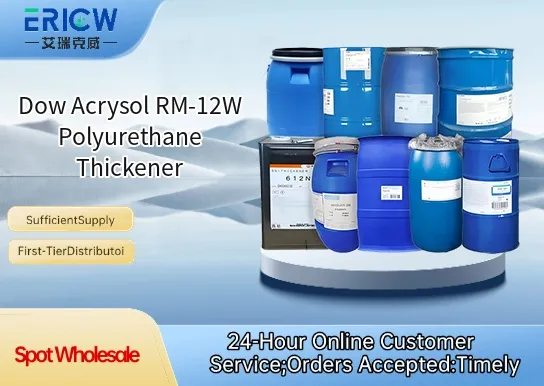
Non-ionic, hydrophobically modified polyurethane (HEUR) rheology modifier for waterborne systems.
Delivers excellent mid-shear viscosity control and outstanding flow/leveling balance.
Provides low-shear viscosity stability and resistance to sagging in vertical applications.
Compatible with a broad range of anionic and non-ionic surfactants, co-thickeners, and biocides.
Enables low-VOC and zero-APEO formulations without compromising performance.
Architectural interior and exterior latex paints.
Industrial maintenance coatings and protective topcoats.
Waterborne wood stains and clear finishes.
Acrylic-based primers and sealers.
Textile and paper coating formulations requiring controlled rheology.
| Chemical Type | Hydrophobically Modified Polyurethane (HEUR) |
| Product Form | Off-white to light yellow liquid |
| Appearance | Opaque, viscous liquid |
| pH (1% aqueous solution) | 6.0 – 8.0 |
| Active Content | 25.0 – 27.0 wt% |
| Specific Gravity (25°C) | 1.02 – 1.06 g/cm³ |
| Solvent Content | Propylene glycol monomethyl ether (PM) and water |
| Primary Applications | Rheology modification in waterborne architectural and industrial coatings |
Q1: What is the primary function of Acrysol RM-12W in waterborne coatings and inks?
A: Acrysol RM-12W is a hydrophobically modified polyurethane (HEUR) rheology modifier designed to provide efficient thickening, especially in low-shear viscosity, while delivering excellent flow, leveling, and sag resistance in waterborne architectural, industrial, and packaging coatings.
Q2: How does RM-12W differ from associative acrylic thickeners like Acrysol ASE or HASE types?
A: Unlike associative acrylic thickeners, RM-12W relies on polyurethane-based hydrophobic associations, offering superior compatibility with surfactants and coalescing agents, reduced sensitivity to pH shifts, and more consistent performance across diverse binder systems—including high-Tg acrylics and styrene-acrylics.
Q3: Is RM-12W suitable for use in high-solids or low-VOC formulations?
A: Yes—RM-12W is specifically formulated for modern low-VOC and high-solids systems. It delivers effective viscosity control without significantly increasing VOC contribution and remains stable in formulations with reduced co-solvent content.
Q4: What is the recommended addition method for optimal performance?
A: For best results, RM-12W should be added during the let-down stage, after pigments and most additives are dispersed. Pre-dilution with water or compatible solvent is advised, and gentle mixing is preferred to avoid air entrapment and ensure uniform association network development.
Q5: Does RM-12W require pH adjustment or special stabilization during incorporation?
A: No—RM-12W is non-ionic and pH-independent, eliminating the need for pH buffering or post-adjustment. It remains stable across typical formulation pH ranges (6–10) and does not interact adversely with common preservatives or defoamers.
Contact With Us:
E-mail: wangxingqiang@ericwchem.com
Have a Questions? Call Us:
Add:
Building A1, Jiete Industrial Park, Huangpu District, Guangzhou City, Guangdong Province, China