English
 Español
 tiếng việt
 русский
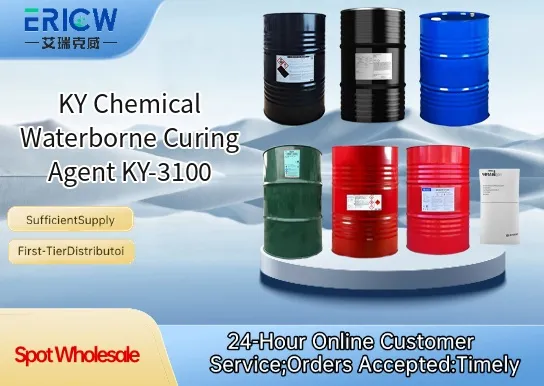
Low-VOC, environmentally compliant formulation meeting global waterborne coating regulations.
Excellent compatibility with acrylic, polyurethane, and hybrid waterborne resins.
Fast ambient-cure performance with full crosslink development within 24–48 hours at 25°C.
Superior film hardness and chemical resistance after curing, including improved alkali and solvent scrub resistance.
Stable dispersion in water with no phase separation or viscosity drift during storage (6-month shelf life under recommended conditions).
Architectural interior and exterior wall coatings.
Industrial maintenance coatings for metal substrates.
Wood finishing systems for furniture and cabinetry.
Automotive refinish basecoat/clearcoat topcoats.
Plastic coatings requiring flexibility and adhesion on ABS and PP substrates.
| Chemical Type | Aliphatic polyisocyanate crosslinker (HDI-based, blocked) |
| Product Form | Opaque white aqueous dispersion |
| Appearance | Homogeneous milky liquid, free of sediment or gel particles |
| pH Value (25°C) | 7.8–8.4 |
| Solids Content (wt%) | 30.0 ± 1.0% |
| Viscosity (Brookfield, RVT, #2 spindle, 20 rpm, 25°C) | 800–1,200 cP |
| Storage Stability (25°C) | ≥6 months in unopened original container |
| Free Isocyanate Content | Non-detectable (<0.1 wt%) |
Q1: What types of waterborne resins is KY-3100 compatible with?
A: KY-3100 is specifically formulated for use with waterborne polyurethane dispersions (PUDs), acrylic emulsions, and hybrid acrylic-PUD systems. It demonstrates good compatibility and reactivity across a broad pH range (typically 7.5–9.0) and performs well in both anionic and weakly cationic dispersions.
Q2: How does KY-3100 affect film formation and final coating properties?
A: KY-3100 promotes efficient crosslinking at ambient to mild elevated temperatures, enhancing hardness, chemical resistance, and scrub resistance without significantly compromising flexibility or clarity. It supports the development of durable, low-VOC films with improved mar resistance and reduced water sensitivity compared to uncured systems.
Q3: What is the recommended addition method and timing for KY-3100 in formulation?
A: KY-3100 should be added under gentle agitation during the final stage of formulation, after pH adjustment and viscosity stabilization. It is generally introduced as a pre-diluted aqueous solution (e.g., 1:1–1:3 with deionized water) to ensure uniform dispersion and minimize localized high-concentration zones that could trigger premature reaction.
Q4: Does KY-3100 require heat curing, or can it achieve full crosslinking at room temperature?
A: KY-3100 is designed for ambient-cure capability, achieving substantial crosslink density within 24–72 hours at 23°C and 50% RH. Thermal acceleration (e.g., 40–60°C for 30–60 minutes) can further improve through-cure and early property development, especially in thicker films or high-humidity environments.
Contact With Us:
E-mail: wangxingqiang@ericwchem.com
Have a Questions? Call Us:
Add:
Building A1, Jiete Industrial Park, Huangpu District, Guangzhou City, Guangdong Province, China