English
 Español
 tiếng việt
 русский
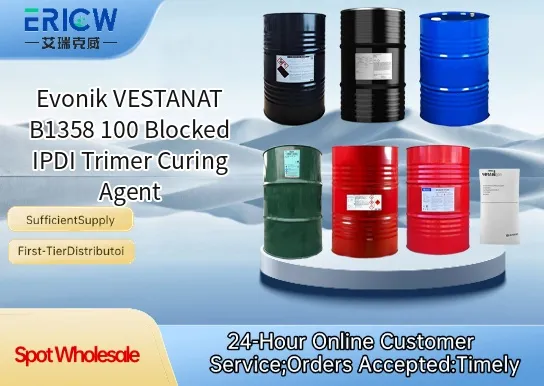
Highly stable blocked isocyanate based on a fully aliphatic IPDI trimer backbone.
Excellent storage stability at ambient temperature with no premature deblocking.
Enables low-bake curing profiles (typically 120–140 °C), supporting energy-efficient processing.
Delivers outstanding UV resistance and long-term gloss retention in final coatings.
Compatible with hydroxyl-functional acrylics, polyesters, and alkyds for high-performance 2K systems.
Automotive OEM clearcoats and topcoats requiring exceptional weatherability.
Industrial maintenance coatings for metal substrates exposed to outdoor conditions.
High-end architectural coatings for aluminum composite panels (ACM) and façade systems.
Powder coating formulations where low-cure reactivity and film integrity are critical.
| Chemical Type | Blocked aliphatic isocyanate (IPDI trimer, methyl ethyl ketoxime-blocked) |
| Product Form | Liquid |
| Appearance | Clear, pale yellow liquid |
| Primary Applications | Two-component (2K) solventborne and high-solids coatings |
| Key Features | Low-bake reactivity, excellent compatibility, UV stability, non-yellowing |
| Benefits | Reduced energy consumption, superior durability, enhanced gloss and color retention |
| Storage Stability | ≥12 months at ≤25 °C in sealed original container |
| VOC Content | Non-VOC (0 g/L as supplied) |
Q1: What is the primary function of VESTANAT B1358 100 in coating and adhesive formulations?
A: VESTANAT B1358 100 serves as a thermally activated, blocked polyisocyanate curing agent based on a fully blocked IPDI trimer. It enables ambient-cure compatibility with hydroxyl-functional resins while providing excellent storage stability and controlled reactivity upon thermal activation—ideal for high-performance two-component systems requiring delayed crosslinking.
Q2: At what temperature does the blocking group dissociate to release active isocyanate functionality?
A: The blocking group in VESTANAT B1358 100 is designed for clean thermal deblocking typically starting around 130 °C, with full reactivity achieved within standard industrial baking cycles (e.g., 15–30 minutes at 140–160 °C). Exact onset and rate depend on formulation matrix, film thickness, and heating profile.
Q3: Which resin types are most commonly paired with this curing agent?
A: VESTANAT B1358 100 demonstrates excellent compatibility with hydroxyl-functional acrylics, polyesters, and alkyds. It is widely used in high-gloss automotive topcoats, industrial maintenance coatings, and coil coatings where low VOC, excellent weather resistance, and mechanical durability are required.
Q4: How does VESTANAT B1358 100 compare to other blocked isocyanates in terms of yellowing resistance?
A: As an IPDI-based trimer, VESTANAT B1358 100 offers inherently superior UV and thermal stability compared to aromatic blocked isocyanates. This translates to significantly reduced yellowing tendency in clearcoats and light-colored finishes, especially under prolonged outdoor exposure or elevated cure temperatures.
Contact With Us:
E-mail: wangxingqiang@ericwchem.com
Have a Questions? Call Us:
Add:
Building A1, Jiete Industrial Park, Huangpu District, Guangzhou City, Guangdong Province, China