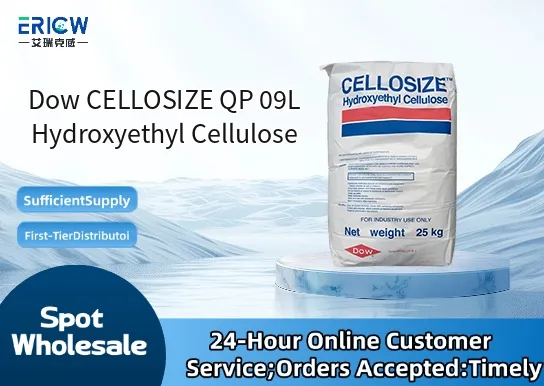
Features Of Dow CELLOSIZE QP 09L Hydroxyethyl Cellulose
Highly water-soluble, non-ionic polymer offering excellent thickening efficiency in aqueous systems.
Provides outstanding suspension stability for insoluble particles and pigments across a broad pH range (3–11).
Delivers low solution viscosity at high concentrations, enabling easy handling and pumpability.
Exhibits excellent film-forming capability and adhesion to diverse substrates including concrete, wood, and metal.
Compatible with common surfactants, electrolytes, and biocides—ideal for formulated industrial products.
Typical Applications Of Dow CELLOSIZE QP 09L Hydroxyethyl Cellulose
Water-based architectural coatings and interior paints.
Cementitious tile adhesives and grouts.
Oilfield drilling fluids and completion fluids.
Pharmaceutical suspensions and topical gels (non-sterile applications).
Industrial cleaning formulations and detergent concentrates.
Specifications Of Dow CELLOSIZE QP 09L Hydroxyethyl Cellulose
| Chemical Type | Hydroxyethyl cellulose (HEC) |
| Product Form | Free-flowing white to off-white powder |
| Appearance | Free-flowing granular or powdered solid |
| Primary Applications | Thickener, rheology modifier, suspension agent, film former |
| Key Features | Non-ionic, water-soluble, pH-stable, salt-tolerant |
| Benefits | Improved sag resistance, enhanced pigment suspension, reduced splatter in coatings |
| Storage Conditions | Store in cool, dry place; protect from moisture and direct sunlight |
| Regulatory Status | Complies with US FDA 21 CFR §172.870 for food-contact indirect additives (as applicable); meets EP/USP general requirements for pharmaceutical excipients |
Dow CELLOSIZE QP 09L Hydroxyethyl Cellulose – Frequently Asked Questions (FAQ)
Q1: What are the key functional benefits of CELLOSIZE QP 09L in aqueous formulations?
A: CELLOSIZE QP 09L provides efficient water-phase thickening, excellent suspension stability for insoluble particles, and good film-forming properties. It delivers pseudoplastic rheology, enabling easy application and reduced sag or drip in coatings and personal care products.
Q2: How does QP 09L compare to other hydroxyethyl cellulose grades in terms of viscosity development and dissolution behavior?
A: QP 09L is a low-viscosity grade designed for rapid hydration and minimal lump formation in cold water. Compared to higher-substitution or higher-molecular-weight HEC grades, it offers faster dispersion and smoother viscosity build with less mechanical shear—making it well-suited for inline mixing and high-speed manufacturing processes.
Q3: Is CELLOSIZE QP 09L compatible with common preservatives, surfactants, and electrolytes found in personal care and household formulations?
A: Yes, QP 09L exhibits broad compatibility with nonionic and anionic surfactants, typical cosmetic preservatives (e.g., parabens, isothiazolinones), and moderate levels of electrolytes. Performance may vary depending on pH and total ionic strength, so formulation-specific compatibility testing is recommended.
Q4: What is the typical dosage range for achieving desired rheological effects in water-based systems?
A: Dosage depends on the target viscosity and application requirements, but QP 09L is typically used at low concentrations—generally ranging from 0.1% to 2% by weight—to achieve effective thickening and stabilization without excessive stringiness or drag.
 English
 Español
 tiếng việt
 русский