English
 Español
 tiếng việt
 русский
High solids content for reduced VOC emissions and improved coating efficiency.
Excellent UV resistance and long-term color stability in outdoor exposure.
Good compatibility with common crosslinkers including melamine and polyisocyanate systems.
Superior gloss retention and surface hardness after curing.
Low viscosity at high solids, enabling easy handling and spray application.
Automotive OEM and refinish topcoats.
Industrial maintenance coatings for metal substrates.
Architectural high-performance exterior wall coatings.
Powder coating base resins for hybrid acrylic-polyester systems.
Can and coil coating formulations requiring weatherability and flexibility.
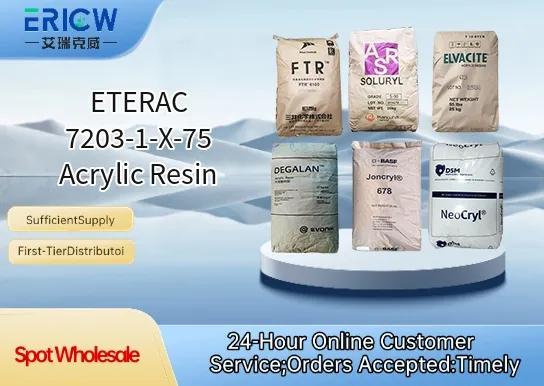
| Chemical Type | Thermosetting acrylic copolymer |
| Product Form | Liquid resin solution |
| Appearance | Clear to pale yellow, homogeneous liquid |
| Solids Content (wt%) | 75 ± 1 % |
| Viscosity (Brookfield RVT, #4 spindle, 25°C) | 2,800–3,500 cP |
| Acid Value (mg KOH/g) | 12–16 |
| Glass Transition Temperature (Tg, DSC) | 68–72 °C |
| Primary Applications | High-gloss, weather-resistant thermoset coatings |
Q1: What is the primary function of ETERAC 7203-1-X-75 in coating formulations?
A: ETERAC 7203-1-X-75 is a reactive acrylic resin designed to enhance film hardness, scratch resistance, and chemical durability in high-performance UV-curable coatings—particularly for industrial wood, plastic, and metal substrates.
Q2: Is ETERAC 7203-1-X-75 compatible with common photoinitiators used in UV curing systems?
A: Yes, it demonstrates broad compatibility with Type I (cleavage-type) and Type II (hydrogen-abstraction) photoinitiators, including benzophenone derivatives and α-hydroxy ketones, enabling efficient free-radical polymerization under standard UV-A/UV-LED exposure.
Q3: How does ETERAC 7203-1-X-75 influence viscosity and cure speed in formulated resins?
A: It offers moderate viscosity reduction compared to higher-molecular-weight acrylics, supporting improved formulation handling; its multifunctional acrylate structure contributes to rapid surface cure and good through-cure depth without excessive oxygen inhibition.
Q4: Can ETERAC 7203-1-X-75 be blended with other oligomers or monomers?
A: Yes—it is fully miscible with common urethane acrylates, epoxy acrylates, and reactive diluents such as HDDA, TPGDA, and IPDI-based monomers, allowing flexible formulation tuning for flexibility, adhesion, or crosslink density.
Contact With Us:
E-mail: wangxingqiang@ericwchem.com
Have a Questions? Call Us:
Add:
Building A1, Jiete Industrial Park, Huangpu District, Guangzhou City, Guangdong Province, China