English
 Español
 tiếng việt
 русский
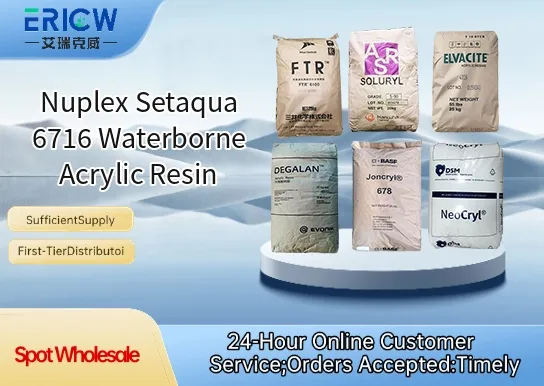
Excellent gloss retention and long-term UV resistance for durable exterior performance.
Low VOC formulation compliant with stringent environmental regulations including EPA and EU directives.
Good hydrolytic stability and freeze-thaw resistance for reliable storage and handling.
Superior pigment wetting and dispersion stability in waterborne architectural and industrial coatings.
Optimized film formation at ambient temperatures without coalescent aids.
High-performance exterior architectural coatings (e.g., premium elastomeric wall finishes).
Industrial maintenance coatings for metal and concrete substrates.
Waterborne wood stains and clear finishes requiring clarity and adhesion.
Plastic and metal can coatings requiring flexibility and corrosion resistance.
Specialty protective topcoats for infrastructure and transportation applications.
| Chemical Type | Acrylic copolymer emulsion |
| Product Form | White to slightly bluish opaque liquid |
| Appearance | Stable milky emulsion, homogeneous without sedimentation |
| Solids Content (wt%) | 48.0 ± 1.0% |
| pH (at 25°C) | 7.5 – 8.5 |
| Minimum Film Formation Temperature (MFFT) | 12°C |
| Viscosity (Brookfield, #2 spindle, 20 rpm, 25°C) | 150 – 350 mPa·s |
| VOC Content | < 50 g/L (as supplied) |
Q1: What is the primary application area for Setaqua 6716?
A: Setaqua 6716 is primarily formulated into high-performance, low-VOC waterborne industrial coatings—especially for metal substrates requiring excellent corrosion resistance, hardness, and gloss retention, such as in general industrial maintenance, agricultural equipment, and light-duty architectural metal finishes.
Q2: Is Setaqua 6716 compatible with common crosslinkers used in ambient-cure systems?
A: Yes, Setaqua 6716 is designed to be compatible with a range of ambient-cure crosslinkers, including melamine-formaldehyde resins and certain blocked isocyanates. Compatibility and cure performance should be verified experimentally within the final formulation due to sensitivity to pH, catalyst type, and co-solvent selection.
Q3: How does Setaqua 6716 perform in terms of freeze-thaw stability?
A: As a waterborne acrylic dispersion, Setaqua 6716 exhibits good freeze-thaw stability when properly formulated—typically surviving at least three standard freeze-thaw cycles (–18°C for 16 h, followed by 24 h at 23°C) without significant viscosity change or coagulum formation. However, unformulated resin should not be subjected to freezing conditions.
Q4: Can Setaqua 6716 be used in direct-to-metal (DTM) coating formulations?
A: Yes, Setaqua 6716 is frequently employed in DTM systems where balanced adhesion, early water resistance, and film integrity are required. Optimal DTM performance typically benefits from synergistic use with appropriate anti-corrosive pigments and adhesion promoters.
Q5: What are the recommended storage conditions for this resin?
A: Store Setaqua 6716 in tightly sealed containers at temperatures between 5°C and 30°C, away from direct sunlight and freezing conditions. Prolonged exposure to elevated temperatures (>35°C) or repeated temperature cycling may affect colloidal stability over time.
Contact With Us:
E-mail: wangxingqiang@ericwchem.com
Have a Questions? Call Us:
Add:
Building A1, Jiete Industrial Park, Huangpu District, Guangzhou City, Guangdong Province, China