English
 Español
 tiếng việt
 русский
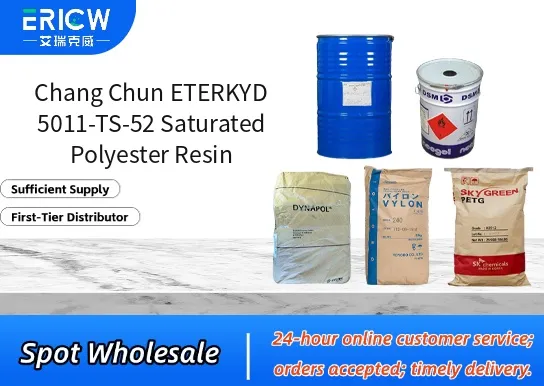
Excellent chemical resistance to solvents, acids, and alkalis in cured coatings.
High gloss retention and superior color stability under UV exposure.
Optimized molecular weight distribution for balanced flow, leveling, and film hardness.
Low volatile organic compound (VOC) content, supporting compliant coating formulations.
Good compatibility with melamine formaldehyde crosslinkers and common additives.
Automotive OEM and refinish topcoats requiring high durability and aesthetic performance.
General industrial metal coatings for appliances, furniture, and outdoor equipment.
Powder coating systems demanding excellent transfer efficiency and smooth finish.
Can and coil coating applications where corrosion resistance and flexibility are critical.
| Chemical Type | Saturated polyester resin |
| Product Form | Clear to pale yellow viscous liquid |
| Appearance | Homogeneous, transparent, free of visible particles or gels |
| Acid Value (mg KOH/g) | 18–22 |
| Hydroxyl Value (mg KOH/g) | 45–55 |
| Viscosity @ 25°C (mPa·s) | 3,500–5,500 |
| Softening Point (°C) | 58–64 |
| Primary Applications | Thermosetting coatings, powder coatings, liquid baking finishes |
Q1: What are the primary application areas for ETERKYD 5011-TS-52?
A: ETERKYD 5011-TS-52 is specifically designed for high-performance coil coating and can coatings, where excellent gloss retention, hardness development, and resistance to humidity and chemical exposure are required. It is also suitable for select industrial maintenance and appliance finishes.
Q2: How does ETERKYD 5011-TS-52 differ from unsaturated polyester resins in terms of performance and handling?
A: As a saturated polyester resin, ETERKYD 5011-TS-52 offers superior weatherability, hydrolytic stability, and reduced yellowing tendency compared to unsaturated types. It does not contain reactive double bonds, eliminating the need for styrene dilution or peroxide-initiated curing — enabling safer handling and more predictable thermal crosslinking with melamine-formaldehyde or blocked isocyanate co-resins.
Q3: What curing conditions are typically recommended for formulations containing ETERKYD 5011-TS-52?
A: Optimal cure is achieved through thermal baking, generally in the range of 180–220 °C for 1–5 minutes, depending on film thickness, substrate type, and co-resin selection. Cure profile should be optimized in conjunction with the chosen crosslinker and catalyst system to balance through-cure, surface appearance, and mechanical properties.
Q4: Is ETERKYD 5011-TS-52 compatible with common crosslinkers used in coil and can coatings?
A: Yes — it demonstrates good compatibility and reactivity with standard amino crosslinkers such as high- and low-methylated melamine-formaldehyde resins, as well as with aliphatic blocked isocyanates. Compatibility and gel time should be verified experimentally when introducing new crosslinkers or catalysts into the formulation.
Q5: What solvent systems are commonly used to dissolve or disperse ETERKYD 5011-TS-52 in coating formulations?
A: The resin exhibits good solubility in typical aromatic and ketonic solvents, including xylene, toluene, methyl isobutyl ketone (MIBK), and cyclohexanone. Formulators often use blends to balance evaporation rate, viscosity control, and environmental compliance — always verifying solution stability and storage life under intended conditions.
Contact With Us:
E-mail: wangxingqiang@ericwchem.com
Have a Questions? Call Us:
Add:
Building A1, Jiete Industrial Park, Huangpu District, Guangzhou City, Guangdong Province, China