English
 Español
 tiếng việt
 русский
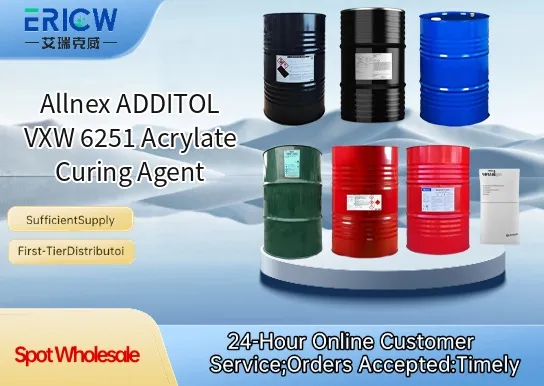
Highly reactive multifunctional acrylate curing agent for rapid UV/EB cure kinetics.
Excellent compatibility with common acrylic monomers and oligomers in free-radical systems.
Delivers superior hardness, scratch resistance, and chemical resistance in cured films.
Low volatility and low odor profile, supporting safer handling and improved workplace compliance.
Enables formulation flexibility for both 100% solids and low-VOC radiation-curable coatings.
UV-curable wood coatings for furniture and flooring.
EB-curable inks for flexible packaging and label printing.
Industrial clearcoats for metal and plastic substrates.
3D printing resins requiring fast build speed and high surface quality.
Electronics encapsulants and conformal coatings demanding thermal stability and adhesion.
| Chemical Type | Multifunctional acrylate monomer |
| Product Form | Liquid |
| Appearance | Colorless to pale yellow transparent liquid |
| Primary Applications | UV/EB-curable coatings, inks, adhesives, and 3D printing resins |
| Key Features | High reactivity, low shrinkage, excellent film formation |
| Benefits | Fast cure speed, high crosslink density, good substrate adhesion |
| Storage Conditions | Store under nitrogen at 15–25°C, protect from light and moisture |
| Stabilizer | Contains polymerization inhibitor (MEHQ) |
Q1: What is the primary function of ADDITOL VXW 6251 in UV-curable systems?
A: ADDITOL VXW 6251 functions as a multifunctional acrylate curing agent that enhances crosslink density, improves surface cure efficiency, and contributes to reduced oxygen inhibition—particularly beneficial in demanding UV-LED and low-energy curing applications.
Q2: Is ADDITOL VXW 6251 compatible with common UV-curable resins such as urethane acrylates and epoxy acrylates?
A: Yes, ADDITOL VXW 6251 demonstrates broad compatibility with standard UV-curable oligomers including aliphatic urethane acrylates, epoxy acrylates, and polyester acrylates, supporting formulation flexibility without significant phase separation or viscosity instability.
Q3: How does ADDITOL VXW 6251 affect film properties such as hardness, flexibility, and chemical resistance?
A: When incorporated into formulations, it typically increases cured film hardness and improves resistance to solvents and mild chemicals, while maintaining acceptable flexibility—especially when balanced with lower-functionality monomers or reactive diluents.
Q4: What is the recommended dosage range for ADDITOL VXW 6251 in typical UV-curable coatings and inks?
A: Dosage depends on formulation requirements and performance targets, but it is generally used at low concentrations—typically ranging from 0.1% to 2% by weight relative to total formulation solids—to achieve optimal reactivity and property balance without excessive brittleness.
Contact With Us:
E-mail: wangxingqiang@ericwchem.com
Have a Questions? Call Us:
Add:
Building A1, Jiete Industrial Park, Huangpu District, Guangzhou City, Guangdong Province, China