English
 Español
 tiếng việt
 русский
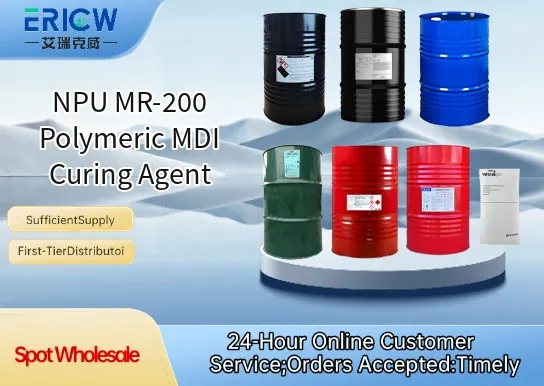
High functionality polymeric MDI with balanced reactivity for controlled gel time and extended pot life.
Excellent compatibility with polyester and polyether polyols in two-component polyurethane systems.
Low monomeric MDI content (< 0.5 wt%) ensuring improved handling safety and reduced vapor pressure.
Consistent batch-to-batch performance due to stringent manufacturing quality control and ISO-certified production.
Enables high crosslink density, delivering superior thermal stability and mechanical strength in cured elastomers and coatings.
Reaction injection molding (RIM) and structural RIM (SRIM) for automotive interior parts.
High-performance polyurethane elastomer castings for industrial rollers, mining screens, and wear-resistant linings.
Two-component polyurethane coatings for corrosion protection of steel infrastructure and offshore equipment.
Flexible and rigid polyurethane foams requiring enhanced dimensional stability and fire resistance.
Adhesives and sealants demanding rapid green strength development and long-term bond durability.
| Chemical Type | Polymeric diphenylmethane diisocyanate (pMDI) |
| Product Form | Liquid |
| Appearance | Clear to pale yellow viscous liquid |
| Isocyanate Content (NCO %) | 29.5–30.5 wt% |
| Viscosity at 25°C | 150–250 mPa·s |
| Specific Gravity (25°C) | 1.22–1.26 g/cm³ |
| Monomeric MDI Content | < 0.5 wt% |
| Storage Stability | Stable for ≥12 months at 15–25°C in sealed containers |
Q1: What is the primary function of NPU MR-200 in polyurethane systems?
A: NPU MR-200 is a polymeric methylene diphenyl diisocyanate (MDI)-based curing agent designed to react with hydroxyl-terminated resins—such as polyols or amine-extended prepolymers—to form crosslinked polyurethane networks. It contributes to enhanced thermal stability, mechanical strength, and chemical resistance in the final cured material.
Q2: How does NPU MR-200 differ from monomeric MDI or TDI-based curing agents?
A: Unlike monomeric isocyanates, NPU MR-200 is a polymeric MDI variant with a higher molecular weight and broader isocyanate functionality distribution. This results in lower volatility, improved handling safety, reduced vapor pressure, and greater formulation flexibility—especially in solvent-free or high-solids coatings, adhesives, and elastomers where controlled reactivity and pot life are critical.
Q3: Is NPU MR-200 suitable for moisture-cure or one-component (1K) polyurethane systems?
A: No—NPU MR-200 is intended for two-component (2K) systems where it is mixed immediately prior to application with a separate polyol or resin component. It is not formulated for ambient moisture-cure behavior and requires stoichiometric blending with active hydrogen-containing compounds to initiate crosslinking.
Q4: What storage conditions are recommended to maintain product stability?
A: Store NPU MR-200 in tightly sealed containers under dry, cool conditions—ideally between 15°C and 25°C—and protect from moisture, direct sunlight, and prolonged exposure to elevated temperatures. Prolonged storage above 30°C or contact with humidity may lead to premature dimerization or viscosity increase.
Q5: Can NPU MR-200 be used in low-VOC or high-solids coating formulations?
A: Yes—its low volatility and compatibility with high-molecular-weight polyols make NPU MR-200 well-suited for low-VOC, high-solids, and even solvent-free polyurethane coatings and industrial finishes where regulatory compliance and performance consistency are priorities.
Contact With Us:
E-mail: wangxingqiang@ericwchem.com
Have a Questions? Call Us:
Add:
Building A1, Jiete Industrial Park, Huangpu District, Guangzhou City, Guangdong Province, China