English
 Español
 tiếng việt
 русский
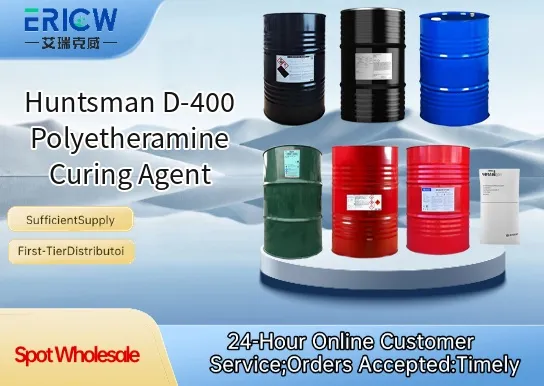
Low-viscosity liquid enables easy handling and efficient mixing with epoxy resins.
Offers extended pot life at ambient temperature, supporting longer processing windows.
Delivers excellent flexibility and impact resistance in cured epoxy systems.
Provides good adhesion to diverse substrates including metals, composites, and concrete.
Contains no volatile organic compounds (VOCs), supporting sustainable formulation goals.
Wind turbine blade bonding and structural adhesive formulations.
Marine coatings requiring corrosion resistance and toughness.
Composite repair systems for aerospace and transportation infrastructure.
High-performance flooring and grouting systems in industrial facilities.
Electrical encapsulation and potting compounds for moisture-sensitive components.
| Chemical Type | Polyetheramine (tertiary amine-terminated) |
| Product Form | Liquid |
| Appearance | Clear, pale yellow liquid |
| Amine Value | 195–205 mg KOH/g |
| Viscosity (25°C) | 150–250 cP |
| Density (25°C) | 0.93–0.96 g/cm³ |
| Reactive Hydrogen Equivalent Weight | ~125 g/eq |
| Primary Applications | Epoxy curing agent for structural adhesives, coatings, and composites |
Q1: What is the primary function of D-400 in epoxy systems?
A: D-400 is a polyetheramine-based curing agent designed to react with epoxy resins, enabling ambient- or elevated-temperature cure to form flexible, tough, and chemically resistant thermoset networks—particularly valued for its low viscosity, extended pot life, and excellent adhesion to challenging substrates.
Q2: How does D-400 compare to traditional aliphatic amines in terms of handling and reactivity?
A: Unlike many conventional aliphatic amines, D-400 offers significantly lower volatility and reduced skin sensitization potential, making it safer and more comfortable to handle. Its reactivity is moderate—providing good working time without excessive exotherm—while still achieving full cure under practical processing conditions.
Q3: Is D-400 suitable for moisture-sensitive applications?
A: Yes—D-400 exhibits relatively low sensitivity to ambient moisture compared to highly reactive amine types, supporting consistent performance in typical industrial environments. However, prolonged exposure to high humidity or standing water prior to cure may affect surface quality and should be managed through standard handling practices.
Q4: Can D-400 be blended with other curing agents to modify performance?
A: Yes—D-400 is commonly co-cured with other amine or phenalkamine hardeners to tailor flexibility, cure speed, chemical resistance, or thermal stability. Compatibility and stoichiometric balance must be verified experimentally for each specific formulation.
Q5: What types of epoxy resins is D-400 typically used with?
A: D-400 is broadly compatible with standard liquid and solid bisphenol-A and bisphenol-F epoxy resins, as well as novolac epoxies. It is especially effective in formulations requiring low modulus, impact resistance, and flexibility—such as protective coatings, composite matrices, and adhesive systems.
Contact With Us:
E-mail: wangxingqiang@ericwchem.com
Have a Questions? Call Us:
Add:
Building A1, Jiete Industrial Park, Huangpu District, Guangzhou City, Guangdong Province, China