English
 Español
 tiếng việt
 русский
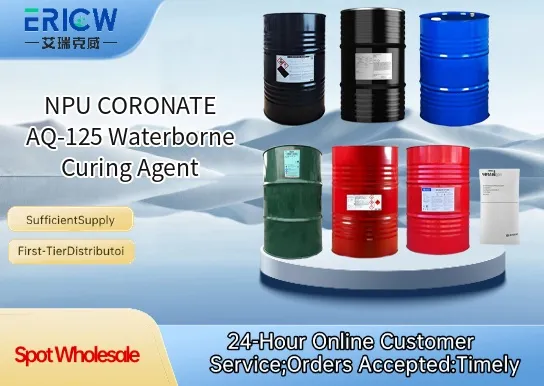
Waterborne aliphatic polyisocyanate dispersion with excellent hydrolytic stability.
Low VOC content, compliant with stringent environmental regulations for industrial coatings.
Enables fast ambient-cure and low-bake performance in waterborne 2K polyurethane systems.
Provides superior gloss retention, hardness development, and chemical resistance in final films.
Compatible with a broad range of waterborne acrylic, polyester, and polyurethane dispersions.
Automotive refinish coatings requiring low-VOC, high-performance topcoats.
Industrial maintenance coatings for metal substrates including machinery and equipment.
Wood finishing systems for furniture and cabinetry where waterborne compliance is mandatory.
Plastic coatings for automotive interior trim and consumer electronics housings.
Architectural and decorative coatings for interior metal and wood surfaces.
| Chemical Type | Aliphatic polyisocyanate (HDI-based) dispersion |
| Product Form | Opaque white to light yellow liquid |
| Appearance | Homogeneous aqueous dispersion |
| Solids Content (wt%) | 30–32% |
| NCO Content (wt%) | 4.8–5.2% |
| pH | 7.0–8.5 |
| Viscosity (25°C, mPa·s) | 150–400 |
| Storage Stability | ≥6 months at 5–30°C in sealed container |
Q1: What types of waterborne resins is NPU CORONATE AQ-125 compatible with?
A: NPU CORONATE AQ-125 is specifically designed for use with aqueous polyurethane dispersions (PUDs), acrylic emulsions, and hybrid acrylic-polyurethane systems. It provides efficient crosslinking in neutral to mildly alkaline formulations, and compatibility should be verified via small-scale compatibility and stability testing prior to full-scale integration.
Q2: How does AQ-125 affect the pot life and film formation of waterborne coatings?
A: As a blocked aliphatic polyisocyanate curing agent, AQ-125 offers extended pot life at ambient temperature due to its thermal deblocking profile. Film formation remains coalescence-driven until activation, typically beginning above 80 °C. The resulting cured films exhibit enhanced hardness, chemical resistance, and scrub resistance without compromising flexibility or clarity.
Q3: Is AQ-125 suitable for low-VOC or zero-VOC coating systems?
A: Yes — AQ-125 is a water-dispersible, non-solvent-based curing agent with negligible volatile organic content. It supports formulators in meeting stringent low-VOC regulatory requirements for architectural, industrial maintenance, and wood coatings when used as directed in compliant waterborne resin systems.
Q4: What is the recommended activation temperature range for optimal crosslinking?
A: Full crosslinking performance is achieved upon thermal activation generally between 80 °C and 130 °C, depending on substrate, film thickness, and dwell time. Lower temperatures may yield partial cure; higher temperatures accelerate reaction kinetics but require evaluation for substrate sensitivity and potential yellowing in sensitive systems.
Q5: How should AQ-125 be incorporated into a waterborne formulation?
A: AQ-125 should be added slowly under moderate agitation to the aqueous resin phase, ideally after pH adjustment and homogenization of other additives. Pre-dilution with deionized water may aid dispersion. Avoid high-shear mixing post-addition and ensure thorough but gentle blending to maintain colloidal stability and prevent premature aggregation.
Contact With Us:
E-mail: wangxingqiang@ericwchem.com
Have a Questions? Call Us:
Add:
Building A1, Jiete Industrial Park, Huangpu District, Guangzhou City, Guangdong Province, China