English
 Español
 tiếng việt
 русский
Excellent melt processability for high-speed extrusion and injection molding.
Outstanding low-temperature flexibility with retained elasticity down to –60 °C.
Superior resistance to UV, ozone, and weathering without requiring additional stabilizers.
Good compatibility with polypropylene (PP) and polyethylene (PE) for robust thermoplastic elastomer (TPE) blends.
Low extractables and compliance with FDA 21 CFR §177.2600 for indirect food contact applications.
Automotive interior trim components including soft-touch dashboards and door panels.
Flexible packaging seals and gaskets requiring thermal stability and compression set resistance.
Medical tubing and connectors where biocompatibility and clarity are critical.
Consumer electronics protective overmolding for ergonomic grips and impact absorption.
Industrial hoses and fluid-handling components exposed to dynamic bending and environmental stress.
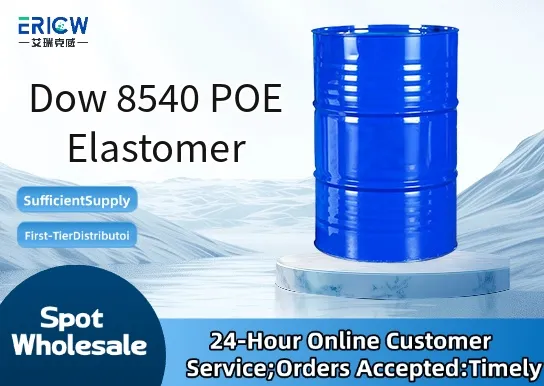
| Chemical Type | Polyolefin Elastomer (POE), ethylene-octene copolymer |
| Product Form | Pellets |
| Appearance | Translucent, cylindrical pellets |
| Primary Applications | Thermoplastic elastomer blends, soft-touch overmolding, flexible seals |
| Key Features | Low density, high resilience, excellent shear stability |
| Benefits | Reduced energy consumption during processing, improved part cycle times, enhanced long-term seal integrity |
| Processing Method | Injection molding, extrusion, blow molding |
| Regulatory Status | Complies with FDA 21 CFR §177.2600; REACH and RoHS compliant |
Q1: What is the primary function of Dow 8540 POE Elastomer in polymer blends?
A: Dow 8540 is a polyolefin elastomer designed to enhance impact resistance, flexibility, and melt processability—particularly when blended with rigid polyolefins such as PP or HDPE. It functions as a compatibilizing toughening agent without significantly compromising stiffness or thermal stability.
Q2: Is Dow 8540 suitable for use in food-contact applications?
A: Dow 8540 is manufactured from FDA-compliant raw materials and is commonly used in food-contact packaging and containers where regulatory approval is required. Final compliance depends on the full formulation, processing conditions, and end-use requirements—users should verify suitability with their regulatory team and consult applicable regional food contact regulations.
Q3: How does Dow 8540 differ from conventional EPDM or EPR impact modifiers?
A: Unlike diene-based elastomers, Dow 8540 is a saturated polyolefin elastomer with excellent resistance to heat, UV, and oxidation. Its metallocene-catalyzed structure provides narrow molecular weight distribution and uniform comonomer incorporation, resulting in superior dispersion, lower viscosity, and more consistent mechanical performance in polyolefin matrices.
Q4: Can Dow 8540 be processed using standard polyolefin equipment?
A: Yes—Dow 8540 exhibits excellent melt flow characteristics and is compatible with conventional extrusion, injection molding, and blow molding equipment used for polyolefins. It typically requires no special drying or pre-treatment and demonstrates good thermal stability under typical processing temperatures.
Contact With Us:
E-mail: wangxingqiang@ericwchem.com
Have a Questions? Call Us:
Add:
Building A1, Jiete Industrial Park, Huangpu District, Guangzhou City, Guangdong Province, China