English
 Español
 tiếng việt
 русский
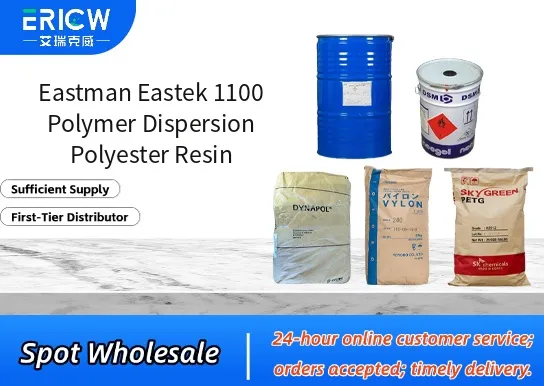
Waterborne polyester dispersion offering excellent film formation without coalescing agents.
Provides superior hardness and scratch resistance in cured coatings.
Exhibits good hydrolytic stability and storage shelf life under ambient conditions.
Enables low-VOC, high-solids formulations compliant with stringent environmental regulations.
Delivers balanced flexibility and chemical resistance for demanding industrial finishes.
Industrial maintenance coatings for metal substrates.
General-purpose waterborne coil coatings.
Interior architectural primers and topcoats requiring durability.
Plastic coatings for automotive interior trim components.
Refinish coatings for OEM-authorized repair systems.
| Chemical Type | Polyester-based anionic polymer dispersion |
| Product Form | White to off-white liquid |
| Appearance | Opaque, homogeneous dispersion |
| Primary Applications | Waterborne industrial coatings, coil coatings, plastic coatings |
| Key Features | Low VOC, self-crosslinking capability, good pigment compatibility |
| Benefits | Reduced formulation complexity, enhanced dry-film performance, regulatory compliance |
| pH (25 °C) | 7.5–8.5 |
| Nonvolatile Content (wt%) | 45–47 |
Q1: What is the primary function of Eastman Eastek 1100 in coating and ink formulations?
A: Eastek 1100 functions as a film-forming polymer dispersion that enhances adhesion, gloss, and surface durability in waterborne systems. It is commonly used as a binder or performance modifier to improve substrate wetting and cohesive strength without compromising viscosity stability.
Q2: Is Eastman Eastek 1100 compatible with other water-based resins and additives?
A: Yes, Eastek 1100 demonstrates good compatibility with common waterborne acrylics, vinyl acetate copolymers, and cellulose derivatives. Compatibility with specific additives—such as defoamers, rheology modifiers, or crosslinkers—should be confirmed through small-scale formulation testing under intended processing conditions.
Q3: How should Eastman Eastek 1100 be incorporated into a formulation?
A: It is typically added during the let-down stage under moderate agitation to avoid excessive shear. Pre-dilution with deionized water may aid uniform dispersion. Avoid exposure to strong acids, highly alkaline media (pH > 10), or freezing temperatures before and after incorporation.
Q4: Does Eastman Eastek 1100 require post-application curing or thermal treatment?
A: No thermal cure is required for film formation—ambient coalescence occurs upon water evaporation. However, elevated temperature drying (e.g., 60–80 °C) can accelerate development of final film properties such as hardness and chemical resistance.
Contact With Us:
E-mail: wangxingqiang@ericwchem.com
Have a Questions? Call Us:
Add:
Building A1, Jiete Industrial Park, Huangpu District, Guangzhou City, Guangdong Province, China