English
 Español
 tiếng việt
 русский
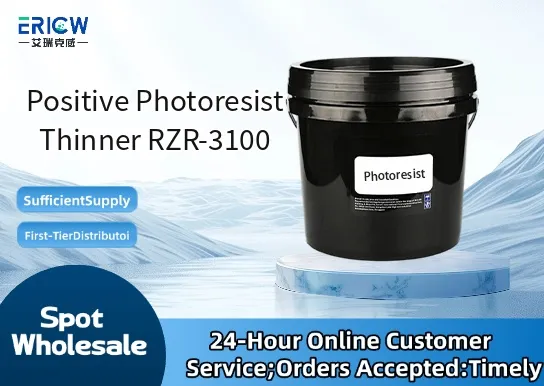
Optimized solvent blend for rapid, uniform dissolution of standard g-line and i-line positive photoresists.
Low residue formulation ensures minimal post-development surface contamination and high pattern fidelity.
Controlled evaporation rate supports consistent film thickness and reproducible coating performance.
High purity grade (≥99.95%) with strict trace metal and particulate control per SEMI C12 standards.
Non-halogenated composition compliant with evolving environmental and workplace safety regulations.
Semiconductor front-end manufacturing: photomask and wafer-level lithography processes.
Microelectromechanical systems (MEMS) fabrication requiring high-resolution resist patterning.
Advanced packaging applications including fan-out wafer-level packaging (FOWLP).
Flat panel display (FPD) production for TFT array and color filter patterning.
R&D labs and pilot lines requiring process-compatible, low-risk resist dilution solutions.
| Chemical Type | Mixed aromatic and aliphatic hydrocarbon solvent blend |
| Product Form | Liquid, ready-to-use |
| Appearance | Clear, colorless liquid |
| Boiling Range | 145–175 °C |
| Density (20 °C) | 0.84–0.87 g/cm³ |
| Primary Applications | Photoresist dilution, viscosity adjustment, and coating optimization |
| Key Features | Non-reactive with novolac/diazonaphthoquinone (DNQ) resists; low water content (<50 ppm) |
| Regulatory Compliance | REACH registered; RoHS 2.0 compliant; no SVHCs above threshold |
| Common Compatible Systems | Suitability |
| JSR TMMR series (e.g., TMMR-P1000, TMMR-P2000) | Highly Recommended – Demonstrated full compatibility and stable shelf life |
| Sumitomo Chemical UVN series (e.g., UVN-30, UVN-40) | Highly Recommended – Verified in spin-coating and pre-bake performance |
| Shin-Etsu SPR series (e.g., SPR-220, SPR-300) | Recommended – Requires minor process tuning for optimal edge bead removal |
| MicroChem S1800 series | Suitable – Compatible with standard processing; monitor for slight viscosity drift at >15% dilution |
Q1: What is the CAS Registry Number for RZR-3100?
A: RZR-3100 is a proprietary multi-component formulation; individual CAS numbers are not assigned to the mixture. Full component disclosure is available under NDA upon request.
Q2: What is the recommended dilution range for standard i-line resists?
A: Typical dilution is 5–12% v/v in undiluted resist; optimal ratio depends on target film thickness and spin speed—validate via DOE in your toolset.
Q3: How does RZR-3100 compare to acetone or PGMEA-based thinners?
A: Unlike aggressive solvents like acetone, RZR-3100 offers superior resist stability and reduced edge bead formation. Versus PGMEA, it provides broader compatibility with non-acrylic resists and lower volatility for improved process window control.
Q4: Is RZR-3100 certified for use in ISO Class 1–5 cleanroom environments?
A: Yes—manufactured and packaged in ISO Class 4 (Class 10) cleanrooms; certified for particle count ≤10 particles/mL (>0.2 µm) and total organic carbon (TOC) <1 ppb.
Q5: Has migration or extractables testing been performed for high-reliability semiconductor applications?
A: Yes—extractables profiling per SEMI F57 shows no detectable leachables into silicon wafers after standard develop/rinse cycles; certified for automotive-grade (AEC-Q200) and aerospace qualification paths.
Contact With Us:
E-mail: wangxingqiang@ericwchem.com
Have a Questions? Call Us:
Add:
Building A1, Jiete Industrial Park, Huangpu District, Guangzhou City, Guangdong Province, China