English
 Español
 tiếng việt
 русский
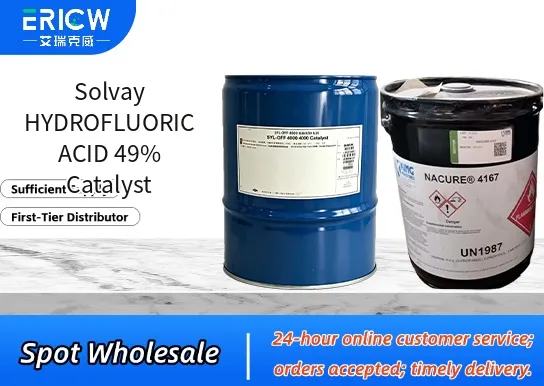
Precisely controlled 49% aqueous hydrofluoric acid concentration optimized for catalytic performance in alkylation processes.
Manufactured under strict Solvay quality assurance protocols to ensure batch-to-batch consistency and traceability.
Low metal impurity profile (e.g., Fe, Al, Si) minimizing undesired side reactions and catalyst deactivation.
Stabilized formulation with corrosion inhibitors compatible with carbon steel handling systems when properly managed.
Supplied in UN-certified HDPE or lined carbon steel containers suitable for industrial-scale chemical transfer.
Alkylation of isobutane with light olefins (e.g., butylene) to produce high-octane alkylate gasoline blendstock.
Catalytic cracking unit (FCC) additive for selective olefin upgrading and isomerization.
Production of fluorinated intermediates in fine chemical synthesis, including fluoroaromatics and fluorinated polymers.
Etching and surface conditioning of silicon wafers and specialty glass in semiconductor and optical manufacturing.
| Chemical Type | Aqueous hydrofluoric acid (HF) |
| HF Concentration (w/w %) | 49.0 ± 0.5% |
| Appearance | Clear, colorless liquid |
| Product Form | Liquid, ready-to-use catalyst solution |
| Primary Applications | Hydrocarbon alkylation, fluorination catalysis, surface etching |
| Key Features | Low metallic impurities, consistent acidity, stabilized for industrial handling |
| Storage Requirements | Below 30°C, away from moisture and incompatible materials (e.g., glass, concrete) |
| Safety Classification | UN1790, Class 8 Corrosive, Packing Group I |
Q1: What is the primary function of Solvay HYDROFLUORIC ACID 49% Catalyst in industrial processes?
A: It serves as a highly effective catalyst in fluorination and alkylation reactions, particularly in the synthesis of high-performance fluorinated intermediates and specialty chemicals. Its controlled acidity and consistent 49% concentration enable reliable reaction initiation and selectivity under optimized process conditions.
Q2: How should this product be handled and stored to ensure stability and safety?
A: Solvay HYDROFLUORIC ACID 49% Catalyst must be stored in corrosion-resistant containers—typically high-density polyethylene (HDPE) or fluoropolymer-lined systems—at temperatures between 10 °C and 30 °C, away from moisture, strong oxidizers, and incompatible metals. Handling requires appropriate PPE, including acid-resistant gloves, face shield, and ventilation, in accordance with institutional HF safety protocols.
Q3: Is this material compatible with common reactor materials used in fine chemical manufacturing?
A: It is compatible with fluoropolymer-lined steel, glass-lined reactors, and certain grades of Hastelloy® and Monel® alloys when operated within recommended temperature and concentration limits. Stainless steel (e.g., 316 SS) and carbon steel are not suitable due to rapid corrosion risk.
Q4: Can this catalyst be used directly in aqueous-phase reactions without further dilution?
A: Yes—it is supplied as a stable, ready-to-use 49% aqueous solution and is commonly employed as-is in hydrolysis, esterification, and deprotection steps where controlled acidic strength is required. Dilution may be applied depending on reaction sensitivity, but is not mandatory for most standard catalytic applications.
Contact With Us:
E-mail: wangxingqiang@ericwchem.com
Have a Questions? Call Us:
Add:
Building A1, Jiete Industrial Park, Huangpu District, Guangzhou City, Guangdong Province, China