English
 Español
 tiếng việt
 русский
Highly selective and stable chromium-based catalyst for propane dehydrogenation (PDH).
Proven long-cycle operation with extended regeneration intervals and minimal activity loss.
Optimized thermal stability enabling efficient performance under high-temperature PDH conditions.
Engineered pore structure and surface acidity to suppress cracking and coke formation.
Scalable manufacturing with strict batch-to-batch consistency and full traceability.
Commercial-scale propane dehydrogenation (PDH) plants producing polymer-grade propylene.
Integrated olefins complexes requiring high-purity C3= feedstock for polypropylene production.
On-purpose propylene units in refineries and petrochemical facilities seeking yield optimization.
Greenfield and brownfield PDH projects utilizing fixed-bed, cyclic regenerative reactor technology.
| Chemical Type | Chromium oxide on alumina support |
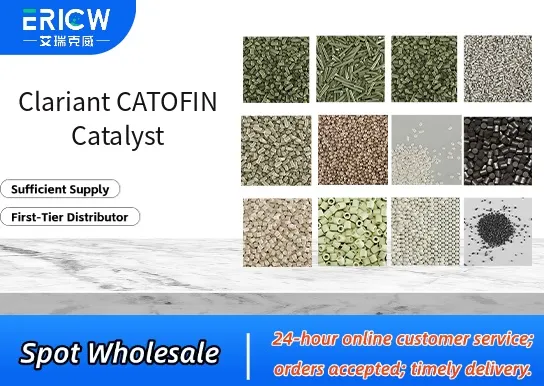
| Product Form | Extruded cylindrical pellets |
| Appearance | Grayish-green to dark green solid granules |
| Primary Applications | Propane dehydrogenation to propylene |
| Key Features | High selectivity, regenerability, thermal robustness |
| Benefits | Reduced operating costs, lower propylene impurity levels, extended catalyst life |
| Reactor Configuration | Fixed-bed, cyclic regenerative (CATOFIN® process) |
Q1: What is the primary application of the CATOFIN catalyst?
A: The CATOFIN catalyst is specifically engineered for propane and isobutane dehydrogenation to produce propylene and isobutylene, respectively—key building blocks for polypropylene, MTBE, ETBE, and butyl rubber.
Q2: How does CATOFIN differ from other dehydrogenation catalysts like Pt-based systems?
A: CATOFIN is a chromium oxide–based, fixed-bed catalyst system designed for high selectivity and stability under cyclic operation. Unlike continuous-flow platinum-tin catalysts, it operates in a multi-reactor swing configuration with integrated regeneration, offering robust performance in high-temperature, low-hydrogen environments.
Q3: What are the key operational advantages of CATOFIN technology?
A: CATOFIN delivers high single-pass conversion, excellent olefin selectivity, and long catalyst cycle life due to its proprietary support formulation and regeneration protocol. Its thermal stability and resistance to coking enable reliable operation across thousands of reaction-regeneration cycles.
Q4: Is CATOFIN suitable for retrofitting into existing dehydrogenation units?
A: CATOFIN is typically deployed as an integrated process solution—including reactor design, regeneration system, and control logic—and is not intended as a drop-in replacement for other catalyst technologies. Retrofit feasibility requires comprehensive engineering assessment of mechanical, thermal, and control infrastructure compatibility.
Contact With Us:
E-mail: wangxingqiang@ericwchem.com
Have a Questions? Call Us:
Add:
Building A1, Jiete Industrial Park, Huangpu District, Guangzhou City, Guangdong Province, China