English
 Español
 tiếng việt
 русский
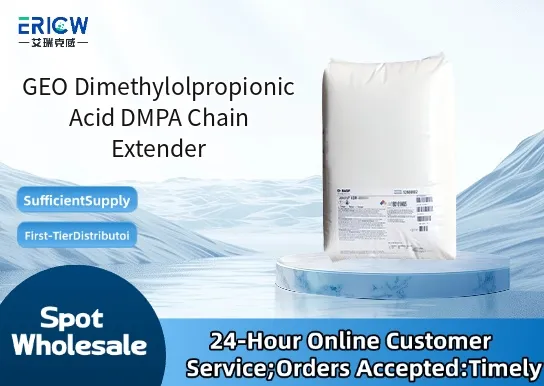
High-purity, low-color DMPA with consistent batch-to-batch performance.
Excellent solubility in common polar aprotic solvents (e.g., NMP, DMF, acetone) and water-dispersible after neutralization.
Two reactive hydroxyl groups enable precise molecular weight control and enhanced crosslinking density in polyurethane dispersions.
Self-emulsifying functionality eliminates need for external surfactants, improving film clarity and hydrolytic stability.
Low volatility and high thermal stability support safe handling and processing up to 180°C.
Waterborne polyurethane dispersions (PUDs) for coatings and adhesives.
UV-curable hybrid polyurethane-acrylate resins.
High-performance textile and leather finishing agents.
Biocompatible polyurethane elastomers for medical device coatings.
Electrode binders and functional additives in lithium-ion battery slurries.
| Chemical Type | Dimethylolpropionic acid (DMPA) |
| Product Form | Crystalline powder |
| Appearance | White to off-white crystalline solid |
| Acid Number (mg KOH/g) | 645–665 |
| Hydroxyl Number (mg KOH/g) | 570–590 |
| Molecular Weight | 134.14 g/mol |
| Moisture Content (by Karl Fischer) | ≤ 0.5% w/w |
| pH (10% aqueous solution, neutralized with TEA) | 7.0–8.5 |
Q1: What is the primary functional role of GEO DMPA in polyurethane synthesis?
A: GEO DMPA serves as a bifunctional chain extender and internal emulsifier, introducing carboxylic acid groups into the polymer backbone to enable water dispersibility and enhance crosslink density, mechanical strength, and film integrity in aqueous polyurethane dispersions (PUDs).
Q2: How does GEO DMPA differ from conventional diol chain extenders like ethylene glycol or butanediol?
A: Unlike neutral diols, GEO DMPA contains two hydroxyl groups plus one acidic carboxylic group, allowing simultaneous chain extension and built-in anionic stabilization—eliminating the need for external surfactants and improving colloidal stability and hydrolytic resistance in final dispersions.
Q3: Is GEO DMPA compatible with both aromatic and aliphatic isocyanate systems?
A: Yes, GEO DMPA demonstrates broad compatibility with common isocyanates including IPDI, HDI, and H12MDI for aliphatic systems, as well as TDI and MDI derivatives for aromatic formulations—though reaction kinetics and final dispersion properties may vary depending on isocyanate reactivity and process conditions.
Q4: What are typical handling and storage recommendations for GEO DMPA?
A: GEO DMPA should be stored in a cool, dry place under inert atmosphere or sealed containers to prevent moisture absorption and oxidation; it is hygroscopic and may form lumps or discolor upon prolonged exposure to ambient humidity or elevated temperatures.
Q5: Can GEO DMPA be used in high-solids or solvent-free PUD formulations?
A: Yes, GEO DMPA is widely employed in low-VOC and solvent-free aqueous polyurethane systems due to its efficient self-emulsifying capability and ability to support stable dispersions at solid contents up to 45–50%, depending on polymer architecture and neutralization method.
Contact With Us:
E-mail: wangxingqiang@ericwchem.com
Have a Questions? Call Us:
Add:
Building A1, Jiete Industrial Park, Huangpu District, Guangzhou City, Guangdong Province, China